I use fun commercial games for speech therapy all the time. Some are valuable as a reinforcer after a turn of saying a sound, practicing a language structure or using appropriate social language. It is helpful if they are fast paced and turns are quick to keep the session going. But some games have a bit of language learning embedded in them too. I have blogged about Richard Scarry’s Busytown and Mystery Garden for learning association and categorization.

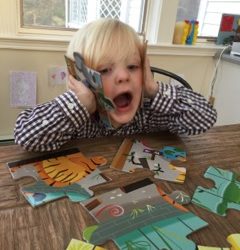
A new game that just came out, S’ Match, by Thinkfun, can be used as a reinforcer or to learn language categories. You have to know the story behind the invention of this game. When I was at the Toy Fair, I spoke with Thinkfun’s Education and Curriculum Specialist and she said the Staples Easy Button and a salad spinner inspired the pop up spinner kids love that turns the dial to point to one of three attributes: color, number or category. Players turn over two cards and try to match images according to the attributes, making this a more complex memory game.

I first used the game with a little girl working on her /s/ sound. Every time we got a match we said, “S’ Match!” and each time we spun the wheel we said, “Spin the s’match.” When it stopped, we said, “I spun color, or category.” Interestingly enough, when kids didn’t make a match according to the spinner, they still called out the kind of match they got. For instance, if they had to match by category but uncovered two orange cards, they would say, “Smatch for color,” making a verbal note of where to find that match should they need it in the future. To reinforce categories, we would say, “a s’match for vehicles,” naming the category. Each sturdy cardboard card has the image as well at the words to encourage literacy.

Don’t forget to always look for a little language in a game.

Sherry Artemenko, MA-CCC, is a speech-languge pathologist with more than 35 years experience and founder of Playonwords.com. The opinions expressed in this review are solely those of the author. “S’Match” was provided for review by Thinkfun.

Since we speech pathologists are required to participate in 30 hours of continuing education every three years, I am always looking for excellent courses to attend. I have shared about Pam Marshalla’s seminar on Persistent Articulation Errors and I want to recommend a seminar I attended yesterday in Long Island, NY.

Summit Professional Education sponsored “DIR/Floortime, Developmental Relational Treatment of Autism and Sensory Processing Disorder,” presented by Esther B. Hess, Ph.D., a developmental psychologist and Senior Clinician for Stanley Greenspan M.D. The course covered how to conduct a clinical assessment and move to a diagnosis, approaches to and principles of intervention, and intervention with severe disorders of relating, communicating and thinking.

As the founder and executive director of The Center for the Developing Mind in Los Angeles, Dr. Hess had a wealth of examples from her work at her clinic on how to work with different kids. She had an effective delivery as she opened with stimulating questions like, “What are the advantages and disadvantages of a diagnosis of autism?” As audience members participated, she asked what their professional affiliation was (OT, PT, SLP, special educators or parents) and then repeated their answer by saying, “Your OT colleague said…” thus  building collaboration among the varied professionals in the room.

Without giving you the content of her material, here are some take-aways I thought were important to share:

  • New studies on brain plasticity suggest that we are capable of generating new brain growth throughout our life. More than once, as we were watching a video tape of a successful session with a child, Dr. Hess said, we just generated new neurological growth. That’s an inspiration to us, therapists.
  • Dr. Hess offered great word pictures to illustrate her points. She talked about living in Southern California where the weather is great but earthquakes are a possibility. In the case of an earthquake, residents are instructed not to make local calls with their cell phones because the signal will be intermittent at best. Instead, have a mutually agreed upon contact across the country to call to say you are safe. She likened the intermittent signal to how kids on the autism spectrum receive information and how frightening that must feel. I have already used that illustration with a neighbor, trying to get her to understand a child in our neighborhood. She got it.
  • We must make great dates with the kids we work with. How much do we love a great date as adults? Great dates validate their experience, they are fun and meaningful.
  • Playdates with typical kids are essential. When typical kids are involved in learning with kids with autism, the typical kids’ emotional IQ goes up. That is certainly something to look forward to with the present generation that is being raised with children with special needs mainstreamed into their classes and activities.
  • Encourage parents to take time with their neuro-typical kids. Go on a great date alone.
  • Our job as therapists is to educate and inform parents, not make decisions for them.
  • Follow the lead of the child but don’t let the child escape from the interaction
I would highly recommend this seminar if you have one in your area. I actually drove two hours to hear this and it was well worth it.
Let me know of other Continuing Education Seminars that you have found to be great in the comments below.

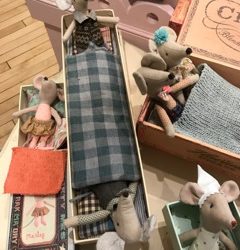
When visiting the International Toy Fair, I was attracted to simple but effective dolls for promoting healthy pretend play. I saw my share of dolls who cry, whine, eat, and make a variety of noises, but my favorites left the fun up to their little owner.

The story behind a great toy is what often fascinates me. Go! Go! Sports Girls dolls was launched when founder and mom, Jodi Norgaard realized she couldn’t find an age-appropriate doll for her 10-year-old daughter that reflected a positive image for young girls, was proportioned properly and sent a message about a healthy lifestyle and giving back to others. So Go! Go! Sports Girls was begun.

Designed to encourage girls to be all they can be–physically, mentally and emotionally–through sports, each doll has “Dream Big” embroidered on her tummy to remind girls to set goals and strive to attain them. An added secret message corresponds to each girl’s sport, as Cassie, the speedy soccer player, has “Score Goals” as her big dream. Her backpack strapped on her back contains a little soccer ball and exercise towel to achieve it.

This multi-cultural gang of healthy girls includes participants in golf, soccer, running, tennis, gymnastics, dance, softball, swimming and basketball. Girls love the zany hair, soft grabbable take along body, huggable friend and backpack of fun. The Go! Go! Girls’ message prompted a discussion with some little girl friends, aged 7-11. What does it mean to dream big? What are your dreams? How are you going to attain them? Little Brooke said, “To make a big goal, like if you shoot a goal with five seconds left and you make it!” “I want to be the best defender.” After reading Cassie’s bio she said, “Speedy, just like me!”

Go! Go! Sports Girls Dolls donates a portion of its profits to Girls, Inc., a national nonprofit organization dedicated to “inspiring all girls to be smart, strong and bold,” teaching our young girls the added message of giving to others to strengthen young women.

What a wonderful companion to a little girl, growing up learning the merit of exercise, generosity and healthy eating and living.

Sherry Artemenko, MA-CCC, is a speech-languge pathologist with more than 35 years experience and founder of Playonwords.com. The opinions expressed in this review are solely those of the author. Go! Go! Sports Girls doll” was provided for review by Dream Big Toy Company. 11-year-old Brooke McKenna, star forward on the Fairfield Black Diamonds, contributed to this review.

Yesterday, I met a mom and a little boy whom I will be working with. He is relatively newly diagnosed with Autism Spectrum Disorder and Mom had a lot of questions. We started talking about reading and she said he loved books but wanted the same one read to him each night. It happened to be a rhyming, repetetive book.

One of the advantages of being a speech therapist in private practice is that I meet with children in their homes so I get to know the family and can “teach” the parents too. I look forward to helping this mom learn what books are beneficial in building her child’s language and “how” to read to him to the best advantage.

First of all, choose books that have a simple story that your child can relate to within his experience (going sledding in the first snowfall, having a Halloween party and making popcorn, going camping, eating, sleeping, playing etc.). Make sure the drawings are simple enough not to distract from the story. I have provided a list of good books I have used here. Set aside some of the fun and wacky Dr. Seuss type of books where kids tend to memorize them and repeat phrases from the book. Instead, offer some books with interesting stories, something to laugh at and keep their interest. Try using dialogic reading which is talking ABOUT the page’s illustrations, not reading the text exactly each time. Since the goal for many kids on the autism spectrum is to generate flexible language, we want to model that for them. Tell the story in a little different way each time, using various describing words and finding a new detail to talk about.

Five loaves and two fish craftI was volunteering in a children’s Bible class this week and loved sitting back watching someone else manage the lesson. I was assigned to help in a 4 year-old class whose lesson was the story of Jesus’s miracle of feeding the five thousand. The kids gathered around a table and started to make their own picnic basket like the little boy who offered his lunch. They were given five cut outs of loaves of bread, two fish and a red checked table cloth, as the teachers told the kids that in Bible times they didn’t have a zip lock bag so they wrapped their food up in the cloth.

It was fun to see how each child had such an individual approach to the craft. They were given a cut off brown paper bag with a pipe cleaner for the handle, lots of glittery fish stickers for decoration, a heart with their verse on it, and the food contents. As they progressed, some completely covered the bag with stickers, others just along the edge, and some started to plan their picnic, One little boy started gluing all his food onto the tablecloth and then added lots of glittery fish stickers. After completing his basket, he got up from the table and announced “I’m going on a picnic!”

I love to see parents evolve into great play partners for their children. Part of the therapy I do with kids is to educate their parents on how to be involved in building their child’s language.

Today I was working with a 2 1/2 year-old who is working on expanding his language and pretend play skills. He really enjoys the Fisher Price Sarah Lynn Camping Adventure–as do most kids so his mom was looking into ordering it. She ran across my review that I had posted on Amazon and was commenting on how helpful it was. I discussed the importance of letting your child be the director of play, while you are the producer. As the parent, you set out inviting toys and props to get your child’s imagination going and prompt a story. This mom said it changed how she played with her child all weekend. She would ask her child, “Where are they going?” or “What should they do now?” as he was moving his little people and vehicles around. When there was a lull in the action, she might give a suggestion, but then hung back again and followed his lead.

Actually it is a lot more fun to sit back and watch your child’s imagination take over. Kids think of things that we don’t. I was just playing with a two year-old with a companion Fisher Price set called the “Fairy Treehouse.” This little girl decided that the fairy should sleep in the barn with the unicorn and share his apples. Then her fairy stood in the trees, supervising the unicorn as he went for a swing. Let your child do the work because that is how she learns.

A Day with No CrayonsI love to read books that connect language with art. A Day With No Crayons is a clever story about a little girl who-you guessed it–lost the use of her crayons for the day. This would be a great book for an art teacher to use to introduce colors. Little Liza loved apricot, fuchsia, tickle-me-pink, and screamin’ green. When she ran out of paper, she decided to continue her drawing on the one blank canvas left, the wall. Just like so many kids who lose themselves in the creative moment, little Liza didn’t realize what she was doing. When Mom snatched up her crayons and put them away for the day, Liza couldn’t imagine a day without them. She managed to create her own palate of colors by squeezing the blue toothpaste, dragging muddy feet on a basketball court, and brushing her grass-stained knees. Suddenly she saw color everywhere. By nighttime, when the crayons were to be returned, Liza had so filled her world with color and pattern that she considered going one more day without crayons.

Use the story for prediction. What will happen when Mom sees the wall? Where will Liza find color without crayons? Take a picture walk before reading the story and describe how she got color on the basketball court or made the camels. Make up fun descriptive words to precede the colors just as Liza did with “laser lemon.” Brainstorm, “Where would you go to find color during your day?”  Finally, make collage pictures of a face, dog or other object showing that art can happen without crayons.

Tomorrow, March 2, is Read Across America Day, celebrated on Dr. Seuss’ birthday!

What better way to celebrate than to help a child make a book of their very own. Whether you are a parent or a speech therapist, this exercise increases kids’ delight in books and reading. Start with some read-alouds by Dr. Seuss. Depending on the age, a fun one to introduce is Hooray for Diffendoofer Day by Jack Prelutsky and Lane Smith. Based on 14 rough drawings and verses left behind when Geisel died, this book was completed in his fashion and is full of Seuss like fun. Once again, the story behind the story is fascinating as editors gathered the drawings and scratched out lines from Geisel’s secretary, revealing the process of his storytelling. I reviewed the story here.

When it’s time to make a book, it can be as simple as stapling a few sheets of paper together to making a book’s covers from a cereal box. Here are detailed directions from alphamom on how to make one with a cover from the Cheerios box.

Use the inside to encourage kids you might be working with on language goals. Write a little story or have them dictate it to you on the computer so you can print it out and glue it in their book. Create a short poem and emphasize rhyming words or add on to a story you have read. Don’t forget to have your little author step in as the illustrator too! Provide lots of markers and colored pencils for the drawings to back up the text.

preschool glitter drawingOne of the goals I have for a child I am working with who has autism, is that he tell two things about his school day, when he comes home. We have tried several approaches to help him remember as well as verbalize what he did. Research shows that if you send something concrete home that relates to their day, you are more likely to have him tell about what he did that day–maybe a leaf if they made leaf prints, or a rock if they talked about rocks. I gave that suggestion to the preschool teachers. They also sent notes home about their activities to prompt our discussions. Still, it was very difficult to get him to share his day.

Last week, I was beginning my therapy session when Mom told of a breakthrough. Her son loves sea animals and recently got a stuffed seal from a visit to the aquarium. When he came home from school and re-attached with his seal, Mom asked the seal what he did at school that day. Her son proceeded to tell about several activities from class that morning! In the same way, his pretend play has taken off as he uses a shark or dolphin to act out pretend sequences since that is his preferred toy these days. At times, we have to restrict the use of the shark or dolphin if he is getting too “stuck” on that toy, but there are ways to use his intense interest on a subject to his advantage.

Bob McGrath from Sesame StreetWhen I was at the Toy Fair last week, I was walking the aisles and noticed a crowd gathering around a man. Of course I had to see who this celebrity was, and there was Bob McGrath, the familiar performer on Sesame Street since the 60’s, signing copies of his “Sing Along With Bob” CD’s for fans.

He graciously posed for a picture with me as I reminisced about collapsing on the couch with my three preschoolers at 4 PM to watch Sesame Street. His recognizable, friendly smile and approachable personality came right through as we chatted about kids and all the media opportunities they have at their disposal these days.

Bob autographed a copy of “Sing Along with Bob #2″ and I went on my way. Today, it was quiet, so I decided to put in Bob’s CD and I went right down memory lane with him! I’m not sure who I will send the first copy to–Great Grandmother who used to sing “John Jacob Jingleheimer Schmidt” to my brother and me and end up in fits of laughter or to my preschool gang. “Boom Boom Ain’t It Great to Be Crazy” took me back to overnight camp memories as we used to wail out that song, resonating in the dining hall, stamping our feet to the “booms.” “The Muffin Man” gave me my first nickname, “Muff” because I loved to dance to the beat.

With thirty four short songs, sung in Bob’s clear, inviting voice, this CD should be in every preschool and therapist’s cache of activities. From “Let Everyone Clap Like Me” to “The Hokey Pokey,” there are many interactive songs that teach listening, following directions and imitating. Little ones will get moving and giggle while “shaking out their sillies” and “jumping out their jiggles.” Parents and grandparents will enjoy the intergenerational experience of sharing songs loved over the years.

Thanks, Bob, for the memories!

“Sing Along with Bob #2″ was provided by Bob’s Kids Music. The opinions expressed in this review are solely those of the author.