I find books to be a great language enriching carryover activity for articulation.
Recently I was working on /s/ and /sh/ with several students and used the book, Bright Stanley by Matt Buckingham to provide practice and carryover for the sounds. Stanley and his school of friends with their shimmery scales provide lots of practice for the /s/ and /sh/ sounds. I read the book in sentences and phrases, pausing to let the child repeat after me. If they are at the carryover stage, simply read the book and have them re-tell it using the pictures. Provide an /s/ word or two to get them going if they get stuck. Stanley is on the hunt for his friends who have the same bright, shimmery scales so there is plenty of opportunity to practice thinking skills like prediction, association and cause-effect too.
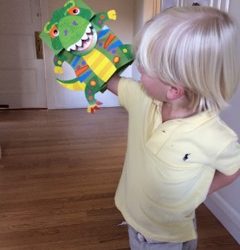
Afterwards, we made our own Stanley, with lots of markers and glitter glue. This Stanley apparently is such a good swimmer he doesn’t need fins!
It’s almost March and we are having two snowstorms out east this week. So even though I see readers requesting Spring lessons for therapy, I am still literally stuck in the snow! Here are a couple of fun books I used today with kids with language delay and on the autism spectrum:
Snip, Snip…Snow! by Nancy Poydar. Little Sophie is anticipating some snow since she has to wear her heavy jacket with the hood and can see her breath. She stomps inside yelling, “No Snow!” as if her mother is responsible for the absence of fluffy white stuff. Finally she gets a favorable forecast but gets up the next morning to no snow again. Arriving at school, she pleads with her teacher to let the class make their own snow. They get to work folding and snipping and making their own flakes. Amidst the excitement of paper snowflakes flying, they look outside to see…you guessed it–real snow! Add some fun at the end of the story and make your own snowflakes, talking through the steps, or shread paper and make a snowman mosaic like Sophie did in the story for a take home, so kids can re-tell the story to Mom and Dad.
Lucille’s Snowsuit by Kathryn Lasky. Little Lucille is left behind to negotiate her snowsuit while her older siblings get a head start in the snow. So many obstacles to overcome–her boots get stuck, her zipper catches, and then she starts to sweat! (reminds me of me trying to go skiing). Finally she gets out in the snow and realizes that her “babyish” snowsuit is the perfect piece of clothing for fun on a snowy day. This is a fun story to re-tell, talk about categories such as clothes, snow activities etc.
First Snow by Emily Arnold McCully. This wordless picture book is a perfect opportunity to take a picture walk with a child. The mouse family piles their sleds into the back of the pickup truck and takes off for the first snow adventure of the season. Packed with vignettes of getting stuck, trudging through the snow, ice skating, making a snowman, sledding and being courageous, this little tale is great for a language lesson.
Now that I have come back down to earth after racing from one booth to another, and seeing all the fantastic new toys and games that amazingly creative people have produced, I want to share my top picks for the most exciting new products, that offer a language building, creative play value. Note, stay tuned for my full reviews when I have had a chance to get my littlest toy testers to weigh in on these toys and games too! This is the first in a series of blogs about what’s hot this season:
Hasbro:
As I mentioned, I was privileged to be included in a preview of their new products the day before the Toy Fair, at their Bloggers’ Breakfast. Here are some toys to be on the lookout for:
FurReal Friends Furry Frenzies. Six furry animals that look like Littlest Pet Shop meets ZhuZhu pets scurried around so quickly that I had a hard time getting a picture of them! Add some accessories for flexible play, their “Scoot and Scurry City,” and watch the bunny, raccoon, puppy or hedgehog chase up the
mountain, stop back in town at the Pet Boutique or visit the Ball Park. Playonwords value: Separate play vignettes offer opportunity for conversation by theme, and the many options to come and go through swinging doors and gates provides flexibility of play.
Play-doh Cake Makin’ Station. You know how I love Play-doh for open-ended creative play, building language and conversation. This toy has staying power celebrating its 50th anniversary of the Fun Factory. Take that fun into the bakery as you add toppings at three different “icing” stations. Kids can stamp out fun frosting patterns and add decorations and colorful toppings at subsequent stations. Playonwords value: The creative process invites lots of chat but take your finished creations and have a tea party. Extend the play using your newly made props!
Wheel Pals Mini-Critters. Kids love vehicles and animals so I think Playskool has a winning combination here. I especially liked the mini, squeezable pals, designed for toddlers’ little hands. Add the jungle, arctic or farm-theme playset tracks for fun and exploration. Playonwords value: Big-eyed faces invite conversation and play, so kids can animate their animals.
Littlest Pet Shop Pet Sitters. Blithe and her friends are the first dolls to be introduced to “Littlest Pet Shop,” just in time to do some pet sitting. Much of what I do is teach parents how to select great toys to enhance language development and demonstrate how to maximize pretend play. When I told a mother of a big fan of “Littlest Pet Shop” that the pet sitters had arrived, she said, “It’s about time they had some people!” Playonwords value: Add people to the mix and you have a new level of conversation and pretend play. Pets and people can teach and learn from each other.
I Can Do That Games:
I am constantly amazed at the creativity and ingenuity that is poured into each of this company’s games. They really get the concept of adding language value to their products.
What’s in the Cat’s Hat. Pick a series of cards with questions to ask to narrow down the solution. “Will it float in the bathtub?” Use some deductive reasoning to guess what object your opponent has hidden in the Cat’s Hat. It took me multiple clues to guess the tangerine (I even got to smell it!). Playonwords value: Look at all the language stretching you encourage as you ask questions, rule out solutions by categories (floats, smells) and make your best guess.
Konexi. Having successfully created games for the preschool set, this company introduced it’s new line for 8 years and up, called Zimbala. (Look it up, it’s a surfing word!) Konexi is a lively wooden set of letters that connect if balanced correctly. Score points by making connections for words. Playonwords value: Obviously this game promotes literacy, letter-sound recognition, and blending. It can be adapted to younger children. Stay tuned for my full review. Check out “Splotcha!” and “Thanks a Lot” too.
International Playthings:
Calico Critters Treehouse. Take your critters to a whole new height with this tree of fun than includes two Mango Monkeys, a hot tub, pagoda, water slide and lake for tons of pretend play fun. Enjoy the four spacious rooms, a hot tub, patio, and trap door to the water slide. Playonwords value: Imagination, imagination, talk, talk, talk. Need I say more?
Yookidoo. Giddy Up Gal and Pirate & Pal Play Sets. Yookidoo has become a favorite of kids and parents,
with it’s inviting faces, bright colors and innovative activities. These gals and pirates are refreshingly new to the kids scene of clip along figures for baby to learn from. Playonwords value: Talk about all the sounds, textures, colors and faces to engage your newborn from the crinkly bandanas to the parrot and pony noises.
I Play. Shop ‘n Cart. This cart carries the whole food shopping experience in one basket on wheels. The set includes the play food, money, packages and cans with a removable grocery basket that fits into it’s own space on the bottom. Playonwords value: Great pretend play to encourage commentary and role playing during play.
I Play. My First Baby Doll. Pretend play comes wrapped up in a diaper bag for on the go fun. The soft, plushy baby doll comes with her teddy bear, bottle, bib, diaper, wipe case and changing pad/blankie. Playonwords value: Great pretend play potential for the younger set as they are just beginning to pretend. The items are soft and can be stored in the diaper bag.
Eebee.
This company carefully researches and introduces quality toys with a purpose.
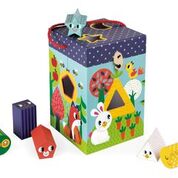
If the Shape Fits eebee. eebee’s got some colorful shapes to share–slip them on his limbs or your own for some fun description and language learning. Playonwords value: vocabulary learning through flexible fun shapes that can be attached to most anything, extending the language concepts to be described. Also, check out eebee’s new baby cookbook coming out soon.
Hape.
Organico Blocks. These light building blocks are made from bamboo and will be out this summer. I can’t wait to try them. Playonwords value: Kids can create anything with a good set of blocks. Add some little people or animal figures and you have a story starting.
Okay that’s it for part 1 of my Top Picks. Next installment is coming including Haba, Playmobil and Blue Orange.
Today I had a press opportunity to have tea with and listen to TIA’s (Toy Industry Association) Toy Trend Specialist, Reyne Rice, talk about the current trends in kids’ toys. Ironically, I had blogged about the same subject last night, based on what I saw after one day at the Toy Fair. I’m proud to say that our lists overlapped a bit!
Reyne knows her subject well and enlightened us with the following four trends she sees, supported by brands:
- Active. We are seeing exercise being brought into toys. This goes along with Michelle Obama’s initiative to reduce childhood obesity and increase movement in kids. Active imagination is in this category which includes arts and crafts and construction. “We are seeing creativity coming back into the fray.” Wild Planet, Hasbro and Mattel all emphasize products that get kids moving. Many companies might use some technology to start the movement. She went on to say that construction toys, arts and crafts, puzzles and games showed the most growth last year in the toy industry. Brands like Crayola, Mega blocks, Playmobil and Legos all encourage active imagination. Active brain includes puzzles like the Rubik’s Cube. We are also seeing games that encourage intergenerational play, providing different levels of difficulty, so various ages can play simultaneously.
- Accessible. We are seeing toys and games whose themes are accessible 24 hours a day, 7 days a week. Kids can go online and play games, or get information on their favorite brands. The hot toy unveiled today was Fisher Price’s new iXL which is their “multi-tech, six-in-one smart device for preschoolers,” according to Robert Eckert, CEO of Mattel. This portable learning unit comes with six applications. It can be used as a photo album or first e-reader product for kids 3 and up. In addition, following this accessible trend, games are being offered with options to play them cooperatively–extending the value of the game.
- Affordable. There are many toys and games coming out in the $10, $15 and $20 range. Twister
Hoops by Hasbro has 5 ways to play the game, extending its play value. According to Rice, it’s the details that delight kids so companies have introduced 3 3/4 inch action figures which have more detail in sculpting and therefore attract more interest. Rice talked about “pennies per play,” the idea of getting repeated value out of a toy or game. Construction toys can be played with in a different way each time. And speaking of the flexibility of construction, several games introduced require the participants to build the game–Lego has buildable mazes and Hasbro’s Mousetrap allows the players to make the gameboard. - Aspirational. Toys and games are teaching kids about empowerment. “I Can Be Barbie” comes in 125 careers. Girls can go online and read about women and the path they took to arrive at their careers. “The Princess and the Frog” teaches perseverance. According to Rice, brands build in, “There’s a choice,” because when children get older they have to make decisions. Also, curriculum based products are in vogue now. You not only can make a light saber, you can learn the physics behind its operation. Thinkfun is giving curriculum to educators and after school programs to extend their products. I met the woman who is heading up the link between their games and learning. She taught kindergarten through second grade and was getting her degree in curriculum when she interned for ThinkFun. The rest is history. She writes the instruction booklets included in the games on how to promote further learning. Good for ThinkFun! Many companies are involved in charitable giving–contributing 3-5% or even 10% of their profits to charities. Karito Kids allows a child who has purchased one of their dolls to log onto the website and choose the charity where she can apply 3% of her purchase price. Included in the aspirational trend are the eco-friendly products. These are made from organic materials, in sustainable factories, with soy based inks, wood, bamboo, etc. Rice cited the example of a company named TDC which offers a green puzzle, where literally when you have worn out the puzzle, you can go outside and plant the puzzle pieces which each have a seed embedded in it. Now that’s what I call recycling.
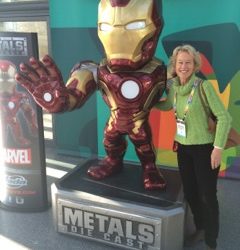
Wow! That’s how I describe the incredible experience of walking through the Jacob Javits Center, filled with inventive, imaginative, and creative people sharing this year’s new products for kids. I was privileged to go to a Blogger’s Breakfast at Hasbro Toys yesterday, as their executives introduced their newest pets, ponies, transformers and Play-doh creation stations to name a few. I will devote a whole blog to that later.
Today, I went to the Toy Fair and saw some great new products for kids that encourage language development through exploration and creative play. First let me share some of the trends that I see in 2010:
- “Green toys” or organic lines. I visited Haba toys today and they introduced Cotti toys which are made from organic fabrics, including a little friend with a removable cushion that can be heated or cooled depending on what a child’s boo boo requires for relief. Organico Blocks by HaPe are lightweight and made from bamboo.
- Toys with a new online connection that links the offline play with an online experience. Hasbro has introduced a new online experience for Littlest Pet Shop. Check out their website with your Pet Shop fans
- Games where the players can determine the length of play before beginning by shortening the board’s path such as Ravensburger’s “Tonga Island,” or choosing one of three different durations for your game of “Monopoly” before beginning to play.
Updated graphics on classics to be more relevant to today’s child. Hasbro’s Candyland board includes baked goods along with the traditional candy and has added such hip characters at the “Duke of Swirl!”- Toys and games to encourage both genders to play with what has been traditionally linked to just boys or girls. Edushape introduced “Chubby Edublocks” in bright colors, including pink, to attract the girls, while International Playthings offers a series of “Wild Science” kits, including a line for girls so they can participate in a perfume lab or make fancy soaps.
- Games designed for friends or siblings of varied ages to play together. I Can Do That Games introduced several clever, engaging games that would be fun for the whole family including “What’s In the Cat’s Hat” and “Konexi.”
What are “Spoon People” you ask? After over 35 years doing speech and language therapy, it is fun to invent something new that really works with kids.
I was trying to think of a way to interest one of my kids on the autism spectrum to re-tell a story. He just recently has become interested in picture books (only if they are the right combination of fun, simple, short, and inviting). I usually have two books in our repertoire, one that is very familiar that we have read and re-told in new ways, asked questions about and done a little predicting, and one that is new to him. Once i get him engaged in the fun and familiar book, I quickly move into the second one before too much protest. Soon the second book becomes the familiar one and so on.
Well now we are moving to re-telling the story. How can we do that in a fun way? I copied pictures of the characters in Timothy Goes to School by Rosemary Wells. I took Timothy, Claude, Timothy’s mom and Violet as my main characters. I glued them to a sturdy cardboard backing and in my search for a stable stick to hold them, I came upon a plastic spoon—and my spoon people were born!
First we took the spoon people and re-told the story. Then we moved to flexibly changing the story. My little friend didn’t like that Claude was mean to Timothy and quickly changed him to a “friend” and invited him over for cookies after school.
Next, I used the spoon people for practice in description. We take turns picking a character and keeping its identity secret while the other person guesses his identity from our clues. My little client held Timothy and said, “He’s nice.” “He is wearing a new shirt.” “He goes home with Violet.”
Spoon people have been known to go on to enter pretend play with a child’s favorite animals to animate. We got out the blocks and Timothy and Violet went to the aquarium with the sharks. Kids love the spoon people because they get attached to and familiar with the characters. They don’t want to leave them behind in a book!
Okay it is almost Valentine’s Day and I am still finding great free downloads for valentines to use with kids to make speech therapy more fun. They’re great for parents to use too for the “homemade” look for those dozens of valentines that are required for distribution to the class.
I discovered the website, www.bunnycakes.typepad.com, a site for “crafting, sharing and the joys of life.” They offer several designs of valentines that are simple to cut out for kids and fun with an animal theme. My favorite is the zebra (which was real popular with a 5 year-old girl today). Other options are the “Love Big” valentines featuring an elephant, sweetheart candy messages and “Love is all you need” valentines.
Add some scissors, glue and cut outs and you have your valentines, decorations for the take home bag, or mailbox.
Using Valentine’s Day books that have a simple story of making valentines, friendship and distributing them to handmade mailboxes or bags can serve as social stories for children on the autism spectrum or those with language delay or disorder. Books like Little Critter: Happy Valentine’s Day, Little Critter! by Mercer Mayer takes your child through the story of getting ready for Valentine’s Day.
And don’t forget, Happy Valentine’s Day!
I notice that a number of people who come to my site are searching for and interested in information on apraxia and speech therapy for apraxia. Parents want to know when and how it is diagnosed and what kinds of therapy they should be looking for to help their child.
I have blogged on this topic a number of times, often related to my view that children are often diagnosed too early or misdiagnosed in this area. I ran across a helpful interview that addresses this issue as well as appropriate therapy approaches, feedback and practice. In the professional magazine, www.advance.com., blogger and speech language pathologist Stephanie Bruno Dowling, interviews Sharon Gretz, MEd., founder and current executive director of CASANA, the Childhood Apraxia of Speech Association of North America. Her interview is very informative and helpful to parents as well as therapists. Several points are emphasized that I agree with:
- Effective apraxia therapy must be approached from a motor planning and programming approach, understanding that children with CAS practice movements that lead to permanent change in their motor system.
- Effective therapy is delivered individually and in short, frequent sessions. I have had parents call me, telling me that their child was diagnosed with Childhood Apraxia of Speech and they were getting therapy in a group, once or twice a week for an hour. Therapy needs to be very specific for a child and include repeated execution of motor movements which is not conducive to group therapy. Several shorter sessions per week have been found to be more effective. In fact, the American Speech and Hearing Association recommends therapy 3-5 times per week for children who are diagnosed with severe to moderate CAS.
- Effective practice by the therapist and parents as well as feedback is important for progress with CAS
- Effective speech therapy for apraxia appears “to include multi-sensory feedback in the form of visual, verbal, or even tactile/touch cues to help guide the child’s speech movements.” Unfortunately there isn’t one method that is right for each child so it is necessary to try different approaches that involve strengthening the child’s internal sensory systems, while giving feedback for correct motor movements. I have blogged in the past about success I have found in using the Kauffman approach as well as PROMPT.
Tags: ues
We are always looking for fun free downloads to use for speech therapy activities. www.alphamom.com has been a great source for free valentines and this year they posted several options for free vintage and retro valentines for kids.
Use them for a reinforcing activity for articulation or incorporate them into a language lesson on spacial concepts, descriptions, sequencing or other goals.
Other options for fun free printable valentines are linked on the site as well. So get out your scissors and glue and have some fun this week!
Today I worked with a little girl who has a word-finding problem. She has difficulty naming words in categories and even understanding categories.
I brought out the “Mystery Garden” game by Ravensburger. The game board is a luscious painting of a path through a garden filled with flowers, animals, a lake, park, farm and so on. A player selects on of the 50 picture cards that are an exact picture of something on the board. The other player has to ask yes-no questions to guess what is on the card. This game of deductive reasoning, vocabulary, association and categories helps build language skills.
It took less time than I thought to teach my 5 year-old client to start with “bigger” questions that were more general dealing with categories. By playing the game, she finally learned what a category was, which was a concept that had been difficult for her to master. I drew big circles on a piece of paper and wrote “toys,” “animals,” “plants” and so on. She quickly understood the group of categories to form a question about in her first line of questions: “Is it a toy?” “Is it an animal?” If she started too specific, I would use the words, “Give me a bigger question.” We followed our questioning with where it was, “Is it in the sky?” “Is it on land?”
Then I needed to show her the next level of questioning based on the category. If I was holding an animal card the options were about attributes: “Does it have four legs?” “Is it furry?” “Is it smooth?” or “Is it big?” She quickly lost the temptation to ask if it was a specific object.
I was amazed at how easily this little girl started to see the hierarchy of questioning based on going from the more general to specific and being able to question according to attributes.
I knew the game was a hit when I found her making up her own cards for guessing when it was time for me to leave. She wanted to continue with Mom!