Whether you’re a parent looking for a rainy day turkey craft or a therapist reinforcing a speech and language goal, it is fun to find interesting crafts for your preschooler to make around this Thanksgiving theme. I have found that kids are motivated to say their sounds, practice their grammar, follow directions and describe their craft when they have a fun project to make. Here are a few resources that can be helpful:
- First-School Preschool Activities and Crafts has several options for making turkeys with maple leaves, hand prints and pine cones.
- Step by Step has turkey book lists, songs and finger plays set to familiar tunes and many ideas for turkey art
- Kinder Plans has Thanksgiving lesson plans with cute crafts to support the lessons like turkeys made from coffee filters, paper bags and hand prints.
- Parents Magazine shares some turkey day crafts and Thanksgiving printables.
As the holidays approach, we start thinking about what to give the kids. Target’s gift catalogue just arrived at the house, and the kids are pouring over it as if it’s an encyclopedia.
There seems to be a new trend, according to an article in the Wilmington News Star this weekend,”Back to Basics” by Kim Cook, reflecting a back to basics attitude among parents, wanting to “lower the volume on tech toys and on children’s environment as a whole.” They are tired of all the plastic in playroom and the noises coming from the toys. They yearn for just a few well-made toys that start the imagination going and will generate some powerful pretend play. A parent just voiced to me the other day that she won’t buy any toy that makes noise, unless there is an off button. That was after I asked her for a screw driver to remove the batteries in the Fisher Price Barn so her son would continue his nice play and not get distracted by the sound effects. I am sure that manufacturers have good intentions of adding all of these sounds for teaching cause-effect, but after several rounds with the toy, the sounds often become a distraction and interrupter of play.
Some of the manufacturers that I like for back to the basics simple, sometimes wooden toys are:
- Melissa and Doug
- Plan toys
- Blue Orange Games
- I Can Do That Games
- Playmobil
- Haba
- Taggies
I was talking to my daughter-in-law today and she asked me if I wanted an idea for a Christmas gift for the kids. Of course I said, “Yes!” I had just been talking to another grandma who had a toy catalogue in her hand for advice but also said she wasn’t going to buy anything the kids didn’t want. With everyone being cautious about spending this year, we don’t want to buy toys or games that won’t be used.
Anyway, Katie asked if we would like to buy a year’s membership in their children’s museum for the kids. I loved the idea. The membership at the Children’s Museum of Wilmington in North Carolina includes many free classes including holiday crafts in the Art Room, “How the Grinch Stole Christmas” storytime by local celebrities, The Cat in the Hat Games (which are REALLY fun by the way), and letters to Santa.
In Connecticut, you know I love The Stepping Stones Children’s Museum in Norwalk, CT. Get a Stepping Stones passport and get it stamped each month as programs present a different country with activities and performances highlighting characteristics and traditions from that country. November is Australia. The next Family Fun Night features Winnie the Pooh for dinner and pictures with Pooh himself. Come to interactive story times and meet the authors.
Another great idea for holiday gift giving by grandparents is to give a year’s subscription to a children’s magazine. My favorites are from National Geographic Kids and The National Wildlife Association. Check out the magazines by age of the child you are giving them to. “Your Big Backyard,” “Animal Baby” and “Ranger Rick” are all favorites with kids.
It’s time to put away the Halloween costumes and talk turkey, preparing for Thanksgiving. Preschools are busy painting feet and hands to provide the body for a feathered turkey, and using play doh for turkey feasts.
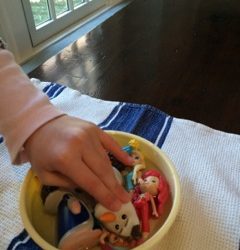
Today I was working with a 3 year-old on /k/ and /g/ and found a turkey to be the perfect thing to get him going with back placement of his tongue. This little guy loves to pretend play with small representational toys, such as the Fisher Price little people, so he started out on a trip to the camping grounds for a picnic and we decided to make turkeys out of play doh. Taking a cooler on our picnic of turkey and gravy offered many opportunities to practice /k/ and /g/.
Max and Ruby were waiting for the feast as we rolled out the dough and used our turkey cookie cutter to make the picnic.
Today I was called in to consult on a little 2 year-old girl who has been receiving services from a Birth-3 provider. I usually ask parents to have all the reports and current goals for me to get an idea of the background on their child. Once again, a child had been labelled “apraxia” and the parents wanted to know what I thought. Personally, I have seen very few children who truly have apraxia in the 35 years that I have been in practice. I have seen many that initially I thought had motor planning difficulties but they settled into therapy and began to show progress and were eventually dismissed.
This little girl was using some 3 word sentences, imitating what I was saying and also had the advantage of just getting tubes put in her ears a few weeks earlier. The parents noticed a dramatic improvement in her speech and ability to imitate. Fluid in the ears and temporary hearing loss can contribute to slow progress and a need for medical intervention.
I gave the parents several suggestions for how they were to respond and talk to their child–not a lot of questions or requests for her to say words, but modelling the words and phrases for her, turn off background music and tapes during your talking play time and talk in 2-3 word phrases during your play time. I offered some suggestions for therapy as well as increasing her frequency of sessions. I am careful not to be invasive when recommending ideas to other therapists because I know that they are doing their best and usually a very good job as in this case. But, sometimes it is helpful to take a step back and view the child through different eyes.
As a speech therapist, we have to be flexible and follow the child’s lead and interests even on the best planned day.
Yesterday, I carried two stuffed bags of toys into the home of 3 year-old Duncan. I had printed out pictures of /k/ words for articulation therapy. I thought he would enjoy cutting and pasting them on cards and loading and dumping them in my variety of trucks. Well, he took a liking to my Fisher Price garbage truck and before we could paste any pictures he was enjoying crumpling them up and loading up the truck, shutting the back to the crunching sound, and hauling them off to the dump!
I got so many responses to my naming the pictures, handing them to him, and his stuffing them in the garbage truck. Of course the pictures didn’t survive more than one session but that way okay. We did what Duncan wanted to do that day and he was full of language as a result!
Wow, I can hardly finish Halloween and the stores are pushing Christmas! I was downtown today and I was re-routed on the sidewalk because they were putting up the Christmas lights. I need to just take a breath.
With that said, I am compiling my list of best toys and games of 2009 to send out soon for those of you who ask what I recommend to build language. If you have any toys or games that were introduced this year that your child really likes and gets them talking let me know in the comments below. I love to get ideas from parents, since you are the best toy testers!
My search for Halloween books that are simple, funny and have lots of language to discuss brought me to two more books that might be helpful to you.
Skeleton Hiccups by Margery Cuyler is a favorite as the skeleton goes through his day, waking up, taking a shower, brushing his teeth and polishing his bones, as his hiccups continue–hic, hic, hic. Each double page is so simple but there is plenty to talk about as his arm comes off while polishing or his jaw flies out as he brushes his teeth! Ghost helps out with several suggestions like drinking upside down and holding his breath. Finally, ghost reaches into his old trunk to get just the right thing to end the hiccups.
T. Rex Trick or Treats by Lois Grambling takes us through the tough process of T. Rex deciding on a Halloween costume. With lots of words in bold for pre-literacy such as EEK and SCARY, this book draws the kids into the story. The illustrations are cute, especially of his dream of being a bat or a black cat with whiskers taped to his nose!
I hope you all have your costumes picked out! Happy Halloween.
Recently, as I was looking on the internet for games to play with my kids on the autism spectrum, I came across autismgames.org, a wonderful site engineered by speech pathologist, Tahirih Bushey.
Her site and blog encourages parents and specialists to learn about how to use games to teach children on the autism spectrum. According to her website it includes:
- Games that will engage young children with ASD in play
- Videos of kids and families playing the games to model play and imitate
- Tips on how to make the play more fun and educational
I listen to the parents I work with and one of the moms said to me last week, “You should blog about parent guilt!” Being a mom of three grown boys, I am well versed in parent guilt. When the elementary school called to suggest reading help for my son, I immediately thought, “Didn’t I read to him enough?” Why is it that we always blame ourselves??
I am privileged to have a relationship of trust with many of the moms and dads with whom I work. They share their struggles with guilt over whether they are spending too much time with the child with speech and language delay/disorder versus siblings, if they have “caused” the problem somehow by missing ear infections or not seeing signs early enough to detect disorders.
First of all, the parents I work with are my heroes. They are full-out working on behalf of their child, implementing techniques in my absence to move their child ahead, learning what toys, books and games are best to stimulate language, changing around the playroom for pretend play or going to seminars to educate themselves on the best therapy for their child.
I often tell parents that we don’t have a crystal ball to foresee the future or be able to assign causes for their child’s speech and language issues. For instance, some children with frequent ear infections during the second year when language is developing, lag in their language development, and other children with the same number of ear infections don’t.
My main point to parents is to try not to look back, but garner your energy and use it to move forward and find the best program of intervention for your child and join in as a partner in the process.