I try to share my challenges and successes in therapy so others can learn from them. As we know, as parents and therapists we have good days and bad days. A good day for me is when a child I am working with shows wonderful progress on his or her goals.
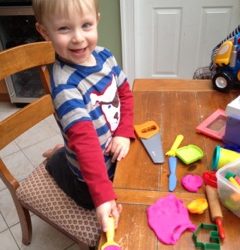
Yesterday I was working with a 4 year-old boy on the Autism spectrum. He is suddenly blossoming in his creative play. Just last summer he was starting to use a little representational person and talk for it following much modeling. During our session yesterday he took his shark (he loves sharks) and took it though nine scenarios, using props to illustrate his story. Our sharks got up and had breakfast (oatmeal and chocolate milk), went to the museum, the beach where we skipped stones in the water (threw Play-doh balls on the floor and counted our skips), piled into a bus and went to Taekwondo (that was a first for me—taking a busload of sharks to exercise!), took a bath, watched a big TV and went to bed in their sleeping bags and Play-doh blankets. Play-doh and simple wooden blocks were our props. As this little boy advances in his play skills, I pick up a block and say, “What is this?” and he incorporates it into play.
I am collaborating with his other therapists and with what goes on at his preschool. When the kids at school are using the block center for pirates, then we reinforce that play theme during therapy, expanding and giving him more ideas to relate at class.
What play ideas have you found helpful when working with higher level kids on the autism spectrum? Share in the comments below.
This entry was posted
on Sunday, December 13th, 2009 at 8:02 am and is filed under 3-6 year-olds, Autism, Language, Preschool, Speech and Language Delay, Strategies to Encourange Language Development, play.
You can skip to the end and leave a response. Pinging is currently not allowed.
I love art and have hopefully instilled that love in my three boys, one of whom is in an art related field. I’ve written before encouraging parents to listen for the language in art with their children.
Recently, I sat out in the garage next to the easel and paints as a three-year-old painted one picture after another. He narrated them for me which was so interesting. The story changed as colors mixed and lines ran into each other. Listening to this picture’s production, I was told that the orange was a giraffe, the green was a T-Rex and the blue was a big wave coming. Here are some ways to get language from art:
Set out the art supplies and watch your child create. Encourage her to tell you about what she is making or has finished
- Display the “picture” so there can be a continued dialogue about what she made
- have her illustrate a story after dictating it to you or writing it herself, encourage detail
- sit with her while she is painting or drawing and have her “tell the story” as she creates
- just sit and listen and you will be treated to her creativity
This entry was posted
on Sunday, December 6th, 2009 at 4:57 pm and is filed under 3-6 year-olds, Birth-3 year-olds, Language, Preschool, Strategies to Encourange Language Development, play.
You can skip to the end and leave a response. Pinging is currently not allowed.
I’ve always been a proponent of play in preschool settings. Based on research, we know that play develops communication skills and social and emotional development.
A recent article in the Washington Post “The Playtime’s the Thing,” supports the importance of play with preschoolers. The author describes a delightful scenario of 5 year-olds playing pretend hair salon using a plastic fork as a hairbrush, taking appointments by phone and curling a client’s hair with an egg beater! In this pretend play, there is more being learned than just taking on creative play roles.
The article goes on to say that “Research has shown that by 23, people who attended play-based preschools were eight times less likely to need treatment for emotional disturbances than those who went to preschools where direct instruction prevailed. Graduates of the play-based preschools were three times less likely to be arrested for committing a felony.”
Play is developing language and social skills as well. More recent research showed that certain kieds of fantasy play helps children learn to control their impulses, which is more closely correlated with academic success in kindergarten than intelligence is.
So why are we decreasing play time in an effort to push academic preparation? Children can learn academic skills through play and it is much more meaningful.
Keep this in mind when chosing a preschool for your child, and looking for a balance in how their day is spent.
This entry was posted
on Tuesday, December 1st, 2009 at 7:40 pm and is filed under 3-6 year-olds, Birth-3 year-olds, Preschool, Strategies to Encourange Language Development, play.
You can skip to the end and leave a response. Pinging is currently not allowed.
As a speech language therapist or parent of a child with language disorders, we want to expand our child’s play, while following their interests.
The other day, I was playing with a little boy with the Fisher Price barn. After getting out the animals, feeding them, playing in the mud, and putting the farmer down for a nap, I started to make some hay out of Play-doh to feed the animals. My little play partner began piling it up in a nest for the chicken. As it got higher and higher, I commented that it was tall. Then he said, “Beanstalk.” So, following his lead, we made a beanstalk that was tall and had the animals climb up to the top to greet the rooster on the roof.
Research shows that when you follow a child’s lead in play and talk about it, they take in more language. You as the parent can suggest a little change in the action, (like make some food for your people or animals) and then sit back and watch your child adapt the story to take in the food. If you child needs more modeling in play, go ahead, but step back when they can start to lead the play.
This entry was posted
on Monday, November 30th, 2009 at 8:09 am and is filed under 3-6 year-olds, Autism, Birth-3 year-olds, Language, Preschool, Speech and Language Delay, Strategies to Encourange Language Development, play.
You can skip to the end and leave a response. Pinging is currently not allowed.
It’s that time of year to make our lists and check them twice–and select the best toys and games for our kids and grandkids for holiday gift giving. Again, there are many helpful lists out there from Parents Magazine to Parents Choice Foundation. Check them out for their carefully toy tested lists, and kudos to Parents Choice who included a section for recommended toys for children with special needs.
Here is my list of favorite toys and games that build language skills through fostering pretend play, encouraging chat, and giving parents plenty to talk about to a baby or toddler:
Babies and Toddlers:
Cuddly Kid Mirror by Alex Toys:
Kids love to cuddle and check out faces so why not get snuggle and face time in one toy? With outstretched crinkle hands, this half ball of fun is asking for play. Strap the “Cuddly Kid Mirror” in the crib for baby entertainment, or prop him up for tummy time and crawl around exploration. Showing off his bright colors, fuzzy textures, knotted strings and bean bag legs, this buddy encourages visual, auditory and tactile investigation and is just plain fun to squeeze.
Recommendated age: Newborn and above
Taggies Go Go! Car
Cuddle up with this friendly-faced coupe, covered with soft plush and shiny geometric designed tags. A takeoff from the popular Taggies balls, this car packs more features for your baby to explore and parents to talk about, enhancing learning. Press the button on top to hear “beep, beep”
and see his cheeks light up, grab the crinkly wheels, see your reflection in the mirrored bumper, play peek-a-boo with a puppy peering out the window or pull the string to start the motion. A combination of textures, vibrant colors, and sounds, this compact car is engineered to give kids plenty to investigate and parents many features to describe, feeding your child important language to encourage learning. His endearing face invites baby’s conversation, providing practice for future chats.
Recommended age: 3 months and up
Favorites from other years:
Taggies First Touch Ball
Taggies Go Go Car was provided by International Playthings.The opinions expressed in this review are solely those of the author.
Flow ‘n’ Fill Spout by Yookidoo:
Toddlers are drawn to running water. Since the best part of bath time is playing with the stream as the tub fills up, imagine the investigating going on with the “Flow ‘n’ Fill Spout” as it keeps the water flowing after the tap is turned off. Submerge the little pump under the water and suction the spout anywhere in the tub for continuous streams of water play. Little ones quickly learn to start and stop the flow by pushing the face, and experiment with the three friendly-faced cups, spinning a propeller, creating a shower and revealing a surprise pop up friend. Teaching the language of empty/full, heavy/light, start/stop, on/off, up/down, and floating/sinking, this joyful distraction makes scrubbing a dirty toddler a little easier.
Recommended age: 9 months and up
Taggies Rocker by International Playthings
Kids lined up for a turn on Taggies’ newest giraffe rocker, swinging a leg over his sturdy, plush back and
hanging on to the handles for a lively ride. Just the right size for a one to three year-old, this playful friend is adorned with bright colors, varied textures, crinkle ears and patterned taggies to amuse the youngest ones while the older toddlers can saddle up and hang on to the mane of ribbons. A plush, huggable friend with a cock-eyed grin, this giraffe leaves the fun and creativity to your child–no batteries needed. He’s low enough to the ground but life-size for kids to invite him into their land of imagination. Don’t be surprised if he is asked to join the picnic or play house. Watching a one-year-old greet him with a morning hug, I know this giraffe can serve to expend rockin’ energy or just be a hang around pal in the playroom.
Recommended age: 12-36 months
Taggies Rocker was provided by International Playthings. The opinions expressed in this review are solely those of the author.
Preschool and Above:
PLAYMOBIL Pyramid:
Take a break from the usual monsters and dragons menu for boys’ pretend play and introduce the ancient life of the Egyptians. Available in the complete pyramid set or smaller sets of chariots, the sphinx, or tomb raiders to name a few, this newest play scenario invites a history lesson as well as creative play. Secret chambers and trap doors set up the fun for chases, captures and discoveries. Kids love to investigate, hide and surprise with all the moving parts to keep the action going.
Recommended age: 5 and up
Playdate Central Puppet Show by International Playthings
Pull out this puppet show in a box when the kids come over to play and watch it spark their imaginations. Mom or Dad can easily assemble the cloth, hanging theater to suspend in the doorway as kids make puppets, part the curtains and start the story telling. Before the show starts, kids create their
own puppet characters with six fuzzy bodies and thirty stick-on ears, faces, tails, noses or outfits. Go traditional in making a prince, princess, lion, puppy, or dragon or combine the features to make an original character. As the story develops, kids can re-figure the puppets, ripping off the reusable features and attaching them to create new characters. Moms were amazed at how well the features stuck on the puppets during active play. My three-year-old puppeteers enjoyed presenting a show and then chased each other with puppets in hand. Language learning begins with selecting a character while devising and assembling the puppets, continues during the creation of the story and dialogue, and extends through open-ended play with flexible props to expand plot possibilities. Take a seat and let your children learn language through play.
International Playthings Playdate Central Puppet Show
Recommended ages 3-6
Playdate Central Puppet Show was provided by International Playthings.The opinions expressed in this review are solely those of the author.
Richard Scarry’s Busytown Eye Found it! by I Can Do That Games
Having raised my kids on Richard Scarry books, searching for Lowly the Worm, I am excited to see a new generation of children examining his delightful drawings, learning about communities of fun. “Richard Scarry’s Busytown Eye Found it! Game” is a winner in innovative, entertaining, language learning games. Unfold the six foot game board and race through the bustling town, busy airport, industrious construction site, and working farm, to board the ferry for Picnic Island to grab your lunch before Pig Will and Pig Won’t eat it. Spin a Goldberg Mystery Card and start the timer as all players work together to spot the most objects on the game board of the kind pictured on the card—construction cones, garbage cans, shovels, kites, or bicycles. Kids love to place their magnifying glass tokens on the objects when found, rewarded with a bonus move. Can you see why I hear squeals of delight when a bug card is spun?
This team game models collaboration, encouragement, patience and the satisfaction of “winning” together. Scarry’s detailed drawings teach the language of concepts, categories, association, and storytelling as little ones learn what objects, people and actions go together to build narratives. Where would we find shovels? Look in the construction site. Where would we search for letters? Check the town post office or neighborhood mailbox. What about garbage cans? Everywhere! Enjoy this game for a balance of talents and fun for kids and adults alike.
Richard Scarry’s Busytown was provided by I Can Do That Games. The opinions expressed in this review are solely those of the author.
Recommended age: 3 years and up
Favorites from other years:
Cat in the Hat-I Can Do That
Horton Hears A Who-You to a Rescue
Green Eggs and Ham-Speedy Diner
Gobblet Gobblers by Blue Orange Games
Assemble your tic-tac-toe grid and off you go with a chance to place three of your gobblers in a row to win. With each turn, players can add a new gobbler to the board or move one that is already in place. Two options–to find an empty space or “gobble up” an existing smaller piece–make this game a multi-leveled game of strategy and memory. Go ahead and move your piece already on the board but don’t forget who was under him, because the littler guy will be left behind in that space and might set up a play for your opponent. Requiring visual-spacial memory and the ability to weigh different strategic options and outcomes,“Gobblet Gobblers” stretches young minds and gets them giggling as they surprise even themselves as opportunities open up to win!
Age: 5 and up
Favorite from other years:
Froggy Boogie
Pengaloo
Step2 All Around Art Tower
There’s fun all around when kids step up to this tower of artistic possibilites. The circular table allows for budding artists to work side by side and select their medium from the two bins surrounding the central pole. Don’t be fooled that this can’t be a language building toy–many kids create stories and narrate their drawings while painting and drawing. Having a friend next to them encourages the dialogue of sharing supplies and talking about what they are making. I love the feature of displaying their finished pictures or works in progress on the clips above the table. Don’t miss a chance to ask your kids about what they’ve made and to tell you the story.
Recommended age: 3 and up
Favorites from other years:
Step 2 50’s Diner
ChickyBoom by Blue Orange Games
Chicks have come to roost on their favorite perch, performing a balancing act on thick bales of hay and slim wagon wheels. Plump Mom and baby chickys peer out their adorable eyes, beckoning players to take turns, skillfully plucking pieces off the teetering perch without toppling the brood. Players remove birds and their accessories, hoping to keep the remaining pieces in place. Each piece has its own point value from one to three, so after the perch is dumped, collect your pieces, add up your score and declare the winner.
A game of fine motor skill and balance, “ChickyBoom” requires slow, precise movements so as not to disturb the roosting chicks. Strategy comes into play as risk takers remove a piece of higher value that might start the gang wobbling but adds value to their winnings. Get some math practice as you add up the numbers on your pieces to reach the highest score and win the game.
Recommended age: 4 and up
ChickyBoom was provided by Blue Orange Games.The opinions expressed in this review are solely those of the author.
This entry was posted
on Sunday, November 22nd, 2009 at 1:06 pm and is filed under 3-6 year-olds, 6-8 year-olds, Birth-3 year-olds, Games, Preschool, Strategies to Encourange Language Development, Toys, play.
You can skip to the end and leave a response. Pinging is currently not allowed.
Whether you’re a parent looking for a rainy day turkey craft or a therapist reinforcing a speech and language goal, it is fun to find interesting crafts for your preschooler to make around this Thanksgiving theme. I have found that kids are motivated to say their sounds, practice their grammar, follow directions and describe their craft when they have a fun project to make. Here are a few resources that can be helpful:
- First-School Preschool Activities and Crafts has several options for making turkeys with maple leaves, hand prints and pine cones.
- Step by Step has turkey book lists, songs and finger plays set to familiar tunes and many ideas for turkey art
- Kinder Plans has Thanksgiving lesson plans with cute crafts to support the lessons like turkeys made from coffee filters, paper bags and hand prints.
- Parents Magazine shares some turkey day crafts and Thanksgiving printables.
If you use any great sites for holiday crafts and reinforcing activities share them in the comments below.
Thanks!
This entry was posted
on Wednesday, November 11th, 2009 at 9:33 pm and is filed under 3-6 year-olds, Preschool, Strategies to Encourange Language Development, play.
You can skip to the end and leave a response. Pinging is currently not allowed.
As the holidays approach, we start thinking about what to give the kids. Target’s gift catalogue just arrived at the house, and the kids are pouring over it as if it’s an encyclopedia.
There seems to be a new trend, according to an article in the Wilmington News Star this weekend,”Back to Basics” by Kim Cook, reflecting a back to basics attitude among parents, wanting to “lower the volume on tech toys and on children’s environment as a whole.” They are tired of all the plastic in playroom and the noises coming from the toys. They yearn for just a few well-made toys that start the imagination going and will generate some powerful pretend play. A parent just voiced to me the other day that she won’t buy any toy that makes noise, unless there is an off button. That was after I asked her for a screw driver to remove the batteries in the Fisher Price Barn so her son would continue his nice play and not get distracted by the sound effects. I am sure that manufacturers have good intentions of adding all of these sounds for teaching cause-effect, but after several rounds with the toy, the sounds often become a distraction and interrupter of play.
Some of the manufacturers that I like for back to the basics simple, sometimes wooden toys are:
- Melissa and Doug
- Plan toys
- Blue Orange Games
- I Can Do That Games
- Playmobil
- Haba
- Taggies
Let me know what your favorites are in the comments below.
This entry was posted
on Monday, November 9th, 2009 at 7:32 pm and is filed under 3-6 year-olds, 6-8 year-olds, Birth-3 year-olds, Games, Strategies to Encourange Language Development, play.
You can skip to the end and leave a response. Pinging is currently not allowed.
I was talking to my daughter-in-law today and she asked me if I wanted an idea for a Christmas gift for the kids. Of course I said, “Yes!” I had just been talking to another grandma who had a toy catalogue in her hand for advice but also said she wasn’t going to buy anything the kids didn’t want. With everyone being cautious about spending this year, we don’t want to buy toys or games that won’t be used.
Anyway, Katie asked if we would like to buy a year’s membership in their children’s museum for the kids. I loved the idea. The membership at the Children’s Museum of Wilmington in North Carolina includes many free classes including holiday crafts in the Art Room, “How the Grinch Stole Christmas” storytime by local celebrities, The Cat in the Hat Games (which are REALLY fun by the way), and letters to Santa.
In Connecticut, you know I love The Stepping Stones Children’s Museum in Norwalk, CT. Get a Stepping Stones passport and get it stamped each month as programs present a different country with activities and performances highlighting characteristics and traditions from that country. November is Australia. The next Family Fun Night features Winnie the Pooh for dinner and pictures with Pooh himself. Come to interactive story times and meet the authors.
Another great idea for holiday gift giving by grandparents is to give a year’s subscription to a children’s magazine. My favorites are from National Geographic Kids and The National Wildlife Association. Check out the magazines by age of the child you are giving them to. “Your Big Backyard,” “Animal Baby” and “Ranger Rick” are all favorites with kids.
This entry was posted
on Sunday, November 8th, 2009 at 4:50 pm and is filed under 3-6 year-olds, 6-8 year-olds, Birth-3 year-olds, Preschool, Strategies to Encourange Language Development, play.
You can skip to the end and leave a response. Pinging is currently not allowed.
As a speech therapist, we have to be flexible and follow the child’s lead and interests even on the best planned day.
Yesterday, I carried two stuffed bags of toys into the home of 3 year-old Duncan. I had printed out pictures of /k/ words for articulation therapy. I thought he would enjoy cutting and pasting them on cards and loading and dumping them in my variety of trucks. Well, he took a liking to my Fisher Price garbage truck and before we could paste any pictures he was enjoying crumpling them up and loading up the truck, shutting the back to the crunching sound, and hauling them off to the dump!
I got so many responses to my naming the pictures, handing them to him, and his stuffing them in the garbage truck. Of course the pictures didn’t survive more than one session but that way okay. We did what Duncan wanted to do that day and he was full of language as a result!
This entry was posted
on Tuesday, November 3rd, 2009 at 11:49 am and is filed under 3-6 year-olds, Articulation, Preschool, Speech and Language Delay, Strategies to Encourange Language Development, play.
You can skip to the end and leave a response. Pinging is currently not allowed.
Recently, as I was looking on the internet for games to play with my kids on the autism spectrum, I came across autismgames.org, a wonderful site engineered by speech pathologist, Tahirih Bushey.
Her site and blog encourages parents and specialists to learn about how to use games to teach children on the autism spectrum. According to her website it includes:
- Games that will engage young children with ASD in play
- Videos of kids and families playing the games to model play and imitate
- Tips on how to make the play more fun and educational
I decided to check out her blog more closely today and found a recent video on the game, “Monster, Monster, Please Come Out.” I loved watching the simple game of one of the participants pretending to be the monster and hiding behind a bean bag chair, while the other players used different emotional voices to call out the monster. They worked together to decided whether to use a happy, silly, scary or mad voice. Finally the monster emerged from behind the bean bag and gleefully chased after the other players.
I tried the game today with one of my kids on the autism spectrum and his mom. We had a hilarious time trading places and calling out the monster. There was collaboration by the remaining players to decide what emotion to use as we called out the monster and lots of interaction as the monster surprised us with a friendly scare.
Before the game even began, I had a good laugh as my little client “hid” himself under the bean bag chair. At least he thought he was hidden.
Check out this site for more fun games to play with kids with ASD.
This entry was posted
on Monday, October 26th, 2009 at 10:44 am and is filed under 3-6 year-olds, 6-8 year-olds, Autism, Games, Language, Preschool, Speech and Language Delay, Strategies to Encourange Language Development, play.
You can skip to the end and leave a response. Pinging is currently not allowed.