Wow. Can you believe it? Finally, at least an implied answer to our question that so many of us have been asking–where is the research to back up the marketing claims of building a brighter baby by showing them videos soon after birth? Parents have been asking me what I think of baby videos, every time I speak to a new parent group. My answer still stands. There is no research I know of that backs up the claims of educational value to a baby, and there certainly is research to the contrary, suggesting a parent use the time more productively.

In yesterday’s New York Times, the front page article, “No Einstein in the Crib? Get a Refund,” explains the events that led up to Disney announcing it will give refunds for Baby Einstein videos, implying that there is no truth to the claims of their ability to increase baby’s brain power.

Thanks to the hard work by children’s advocacy groups like The Campaign for a Commercial-Free Childhood, the American Academy of Pediatrics and Children’s Hospital of Boston’s Center on Media and Child’s Health (CMCH), the truth is finally out.

Successful marketing campaigns to tout the educational factor of baby videos apparently worked because, according to a 2003 study, a third of all American babies  from 6 months to 2 years had at least one “Baby Einstein” video. Moms and dads were clearly convinced that they needed to share this video experience with their infants to be responsible parents.

Luckily, parents can be released from the guilt of being “the perfect parent” and use the valuable time with their infants to play, talk and read, interacting where babies learn the best–with a person and in their daily experience.

play bugs and Play-dohI shared some of my favorite Halloween books last week and have used them when working with kids with typically developing language as well as those with auditory processing difficulties, and those on the autism spectrum. I had quite a fun time with Aaaarrgghh: Spider! with a little fellow on the autism spectrum that I wanted to share.

Our goals include being attentive to a book and answering wh-questions as well as building pretend play skills. It all came together with this goofy book about a spider campaigning to be the family pet! We started out with my wonderful collection of bugs, including spiders, a jar with a magnifying lid, Play-doh of course, and some little Fisher Price furniture and playground items.

We talked about the spiders, chose different ones to look at under the magnifying glass and then read the book. I pointed out the faces of the family and reactions to the spider’s attempts at winning them over. We copied surprised, scared and happy faces. Then we got out the Play-doh and made a web, stuck the flies and bugs in it for eating, and hung the spider down from the web to dangle over our dinner, as in the book. We copied the reactions of the family at the sight of a spider waving over our food.

Then, much to my delight, my little friend took off in his play. I was holding a fly and he had the spider when he hid the spider under a mound of Play-doh and started counting. I followed his lead of starting a game of hide and seek with our bugs! We took turns searching for each other’s bugs and he created two new spots for hiding–great flexible play. Then I got out my Play-doh oven as an option for a hiding place. After our bugs hid in it, he piled several bugs in and started to lift it up with sound effects. I asked what he was doing and he said, “It’s landing.” When I asked what is was (the oven), he said, “A plane.” Wow! That was an exciting step up in pretend play to assign a different use to an object than what is it intended for. He proceeded to fly his “plane” around the room on its way “to London” before it had to land so the bugs could go home.

Little steps like that make my day.

preschool costumesI was at a house this week where a clever mom decided to re-do the playroom. She took all the costumes for pretend play out of the wooden chest where they were ignored and hung them on hooks for ready play! I asked my 4 year-old friend who he would like to be and he pointed to the fireman’s jacket. We snapped him into his coat, gave him his hat, handed him his inflatable hose and we were off to put out a fire. Mom and I had the ax, fire truck, walkie talkie and fire extinguisher.

But where was the fire? He pointed to a pop up hut and said at that house. I pointed out to mom that having a structure for pretend play will encourage creativity, whether it is a cardboard box big enough to fit some preschoolers, a kids’ pop up tent or hut, or some floor mats that are flexible enough to form into a house. Use that structure for your doctor’s office, barber shop or house on fire.

You can pick up children’s costumes at Halloween time, at tag sales or on the Internet any time.

News 12 Connecticut, 12 on Health, Stepping Stones MuseumToday I was interviewed for News 12 Connecticut TV at the Stepping Stones Museum to comment on how to encourage language development as your child visits the museum. Aside from my comments on talking about what your child is experiencing using rich vocabulary–the swirling, whirling water circling in the tank, and participating in pretend play with your child as he dons the different coats and costumes for each exhibit, a dentist’s coat, tool belt for “Build It” or an explorer’s vest in “The Rain Forest,”  I learned about the expansion and upcoming plans for the museum.

I enjoyed meeting Carol Brennan-Smith, Director of New Ventures at Stepping Stones Museum as well as Kim Kuta, Content Specialist for the Exhibits and catching their enthusiasm for the new building project and expansion at the museum. Infants and Toddlers will walk down “Alphabet Alley,” being introduced to their letters and sounds before entering the newly expanded area for children 36 months, and under. Taking off from a world of nursery rhymes, this new space will have a bus (Wheels on the Bus), farm (Old MacDonald), Jack and Jill slide and Mary Mary Quite Contrary’s Garden.

It’s always fascinating to watch Jillian Neff get the best story. She was particularly adept at hearing from some 3 and 5 year olds as they experienced the exhibits.

toddler eatingMany of you e-mail me with tips and ideas that bring out language in your preschoolers. I appreciate ideas from moms who are out experiencing life with their little ones daily. Here is a recommendation for a snack that can stimulate language learning:

“Hi, Sherry,
I got a new snack for Alexandra at the grocery store this week that is SO cute and great for language.  They are called Bug Bites by Keebler.  Basically, they are graham crackers in the shape of different bugs including a butterfly, caterpillar, ladybug and firefly.  The great thing about them is that they look like real bugs, so they are a great conversation piece.  They are also a healthy snack — good source of whole grains and calcium (taste good too I might add).

Just wanted to pass this along as a possible tip for moms!  Alexandra LOVES bugs so they are a huge hit in our house!”

So snack on and talk before you bite!

Stepping Stones Museum, CTI had heard nothing but fantastic reviews from parents about the Stepping Stones Museum for Children in Norwalk, CT. A visit from my one and a half and three year-old grandchildren prompted my first visit there today. Wow is all I can say.

Try to choose between the “Waterscape,” “Rainforest Adventure,” “Toddler Terrain,” “Build It” or “ColorCoaster.” Each exhibit is just enough to digest and kid-sized for attention spans and interest. We hardly got past the “Waterscape” room, where we were offered a plastic smock to keep kids dry as they explored fog, currents, whirlpools and waterways. Plenty of realistic play turtles and crabs and were available for swimming in the pools of water.

Stepping Stones Museum, CTNext, we discovered the “ColorCoaster,” a 27 foot kinetic sculpture–a giant mechanical toy whose balls were whipped, dropped, and cascaded along metal trails, gathered by the arms of a gorilla or rolled into the mouth of an turtlle. Ben, 1 1/2, who loved balls, was so fascinated, we had to pull him away to the next exhibit.

Putting on the appropriate costume for each exhibit encouraged the pretend play as kids wore dental coats to examine a larger than life set of teeth, a doctor’s coat to drive the ambulance and work the walking talkie in “Healthyville,” a fireman’s coat to put out a fire, or a tool belt in “Build It” to construct a project. “Toddler Terrain,” designed as a safe place for toddlers to explore on slides, shapes and projects just their size, even had a rack of costumes to choose from–bug wings, ladybugs or bears.

Since much of the research emphasizes the importance of play in building language skills that under gird academic skills, this is a place to let your child loose to explore.

stepping stones Museum, CTBesides the benefit of creative, interesting, interactive exhibits for kids, this museum is a resource for parents and educators. With an emphasis on raising healthy kids, their programs educate the community through activities for families and school groups. They have a resource library with tubs of language enhancing toys as well as a library of books that can be checked out for use at home.

If you are within driving distance or planning a trip to the East Coast, make sure the Stepping Stones Museum for Children is on your itinerary. As we left, my adult son said, “This is better than the Children’s Museum in Boston.” That’s quite a compliment!

When I arrived at the home of one of the kids I work with who is on the Autism Spectrum, I saw a long tunnel he had made out of cardboard blocks that ran the length of the room. Mom said he is into tunnels these days. I admired his architectural structure and then gave some tips to expand his play. Kids who are on the autism spectrum can get “stuck” in their play on certain concepts or objects such “holes,” “tunnels,” “switches,” or a specific play person such as the “king” or the “alligator.” When this happens, parents and therapists have to be creative to keep the interest of the child but model flexible play that might include what he is so interested in, but expand on it and grow his language.

Mom had thoughtfully added cars to bring in some action. Best to include cars or vehicles that hold people for some interaction and conversation. I suggested she take a few more blocks and build a structure at the end of the tunnel for play such as a parking garage, or a restaurant or a house to go to after exiting the tunnel. The object is to take advantage of his interest in the tunnel but then expand the play with something related to it. Bring the cars through the tunnel and then have your people stop in for lunch.

Think of scenarios that will encourage story telling and creative play. Continue to model conversations and stories, pausing to let the child imitate or expand on what you are saying.

Baby Newborn ToysLamaze Play and Grow Logan the Lion’s big eyed face attracts newborns and invites conversation. His ribboned mane, different textures, slippery ribbons, shiny nose, fuzzy cheeks, bumpy rings, smooth tummy, star with ridges and bumps, and crinkly feet provide lots of textures to talk about. With a head as a rattle, crinkly feet, and clanging rings, this zoo attraction will stimulate the senses with its sounds. Check out the contrasting patterns and colors to draw attention to this friend and provide lots to describe.

Manhattan Toy’s Put and Peek Birdhouse is a favorite of mine. What child wouldn’t like a portable playhouse for birds with a handle for safe travel? The many openings to put birds through, in, out, and doors to open and shut, provide the language of position and prepositions. Each little bird is distinct and can be described by its contrasting colors, size and shape. Little hands can easily grip these birds to start the fun.

Alex Jr. Round the Farm is a friendly four-sided ball with plenty of plush for a toddler’s grip. Each side sports the face of a different animal–cat, frog, pig and dog. Four faces combine contrasting patterns, textures and colors to entertain baby and invite exploration. Fuzzy protrusions, for ears, tails, or feet, are easy to grab to rotate the ball to meet a new barnyard friend. A little squeeze on the ear brings on a ribbit, meow, oink or woof, corresponding to the animal’s face. Babies love a squishy ball that they can easily grab, roll or manipulate to hear sounds, feel textures, see faces, or stick their finger in a fuzzy hole. An inherent preference for faces drives baby’s curiosity to explore, and eventually “speak” to a face on this delightful ball of fun.

Baby Cakes is a wonderfully rhythmic, bouncy tale about ones love for their baby, as a toddler expresses his love for his teddy bear. Providing plenty of opportunity to add gestures to the story, this book encourages bouncing on the lap, clapping, playing peek-a-boo, laughing, singing and hugging.

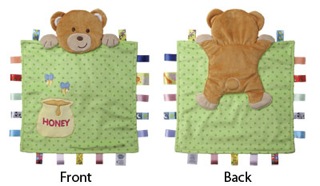
Taggies Big Soft Blocks are for grabbing, turning, tasting and exploring. From a shiny sunshine to a woolly sheep, each object combines a variety of shapes, textures and colors to invite a child to play. Plastic rings allow one to clip them together so they can tag along on a trip or a diaper bag.

Manhattan Toy Dress Up Princess is ready to play pretend beginning at 18 months. Practice with the buttons, snaps, zippers and ties or leave the dress up for later and have a pretend picnic, outing or school lesson with this new pal.

cardboard box for playToday I arrived at the home of one of my students who is on the autism spectrum. We enjoy playing games, playing pretend  and reading books for learning.

He took me right to a big cardboard box on the floor that was laid sideways with both ends open. He announced that it was a tunnel. I got out my Fisher Price little people and vehicles, let him chose a figure (Papa) while I took the Mama and we started our play and conversation. The goal was to have him engage in conversation using his Papa figure while I talked back with mine, moving him from what could be perseverative behavior or talking (in relation to the tunnel) to flexible language. Therefore I set up different play scenarios, one at a time, to encourage flexibility.

After a chat, he ran his car with Papa through the tunnel and I put out a slide for a playground. He turned Papa over on his tummy and started to count to 10 and we were playing hide and seek. I got so excited! When it was my turn to hunt for Papa, I modeled different places to look–”Is he under the slide?” “Is he behind the bike?”  Then I added a prop or two for his turn to see if he would generalize and use them for hiding places too. I continued to model, pull back and let him respond, add a prop or two and expand the play.

As we continue to play, I see progress in his ability to follow my models for play and occasionally add a novel action. These are little successes as my friend learns to play pretend.

Fisher Price trainYesterday when I was interviewed for Channel 12 News about what to do when your 2 year-old isn’t talking, I talked about the process to go through to get your child evaluated, but also mentioned what to do to stimulate language.

Here are some tips:

  • Label objects, people, movements in your child’s environment that they are experiencing. “I hear the dog barking,” or “the tree has green leaves.”
  • Pause after naming things like “juice,” “cup,” “train,” and see if your child attempts to imitate you.
  • Talk about what your child is doing, feeling, hearing or thinking as they play and experience the day. “The sand must be scratchy on your leg,” or “That truck is going fast.”
  • Don’t ask a lot of questions because that can actually inhibit language since it puts a child on the spot. Let them talk and express themselves, even if we don’t understand them!
  • Use language enriching toys that move, have people, invite creative play and have props for many settings (eating, sitting, traveling, sleeping etc.) Yesterday, I used this Fisher Price Li’ Movers Motorized Train to give people rides, buys tickets, make a phone call or visit the farm.