I have often told parents that they should be the Producer, not the Director of their child’s pretend play, meaning, set out some fun toys and objects and let your child create the story with the props.
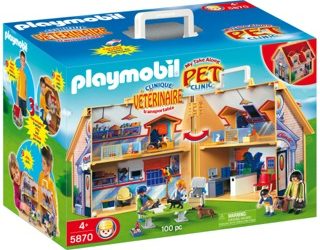
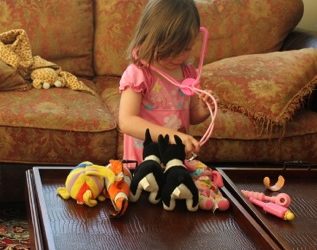
Today I was playing with Reagan with the pretend hospital including the doctor, patient in a cast, x-ray machine and baby nursery. After we had played for a while, mom got up and passed by dropping a stethoscope on the table. Next thing you know, Reagan was combining her life size props with her smaller representational toys. She had the doctor pinned to the floor while she was listening to her heartbeat.
Mom did just what she should do–add a little something for play to extend it or move the story along. This will not only lengthen her child’s attention span for this play but also build a new language story.
What combinations of toys does your child like to play with? How do you combine toys? Share in the comments below.
Whenever therapy needs a little excitement, I bring out the glitter glue! This week I added a pad of paper, markers, plastic wiggle eyes and glitter glue to my bag. Preschool girls and boys alike just love to squeeze glitter glue all over their picture.
Again it can be used to elicit many sounds or language targets that you are working on. I got an initian “sh” because we had to “shake” the glitter bottle several times before squeezing out the glitter, or “is” for “that is the purple.” Use it as a reinforcer for what ever you are working on.
Here we are making a butterfly who happens to have pink jiggle eyes. Crafts are always interesting to kids and especially glue because it is messy. It usually doesn’t take long for kids to figure out that it is more fun to move the glitter glue around with their hands.
A little aside today–this is what makes my profession funny. The little girl who was creating this masterpiece looked up at me and said, “You look like a grandma.” I checked out what I was wearing to see if I was a bit frumpy today, and asked, “Why?” She said, “Because of your neck!” I didn’t ask any further questions:)
Any speech therapy practice is constantly changing–clients are being dismissed and new ones are beginning therapy for the first time. It occurred to me that I should blog about some of the expectations that parents have who are new to the preschool therapy process.
- The speech therapist has all the answers. We don’t know all the answers immediately. I am often asked, “How long will this take?” Will he learn to talk?” I tell parents that I don’t have a crystal ball and can’t answer those questions. Certainly, after I have seen a child for several weeks or months, I have a better idea of whether they are responding quickly to therapy or if they are progressing more slowly, whether it is a simple delay or might involve a disorder. This can be shared with parents although kids are always surprising me and they may take a jump in their progress at any time.
- Things should go smoothly from the start. Kids need to adjust to the therapy process. Even though preschool therapy should be provided through play so kids love it, it is still an adjustment for a 2 or 3 year-old to pay attention to an adult for 45 minutes to an hour. It is up to the therpist to change activities often enough to keep a child’s interest, but intially you might be just teaching that the child has to say something to get something (Isn’t that the jist of communication?) Up until now, a language delayed preschooler has developed their own tactics for getting what they want–ranging from screaming, grunting, pointing etc. Now they are being rewarded for verbalizing, even if it isn’t clear, to get what they want, which is the beginning of successful communication.
- I want to be involved but how? Parents need to be educated too. Parents should be an integral part of preschool speech therapy. Hopefully they can be sitting in on the sessions, learning how to encourage specific speech and language progress. I always share exactly what I am working on, how I am doing it, and how much to push without ever frustrating a child. Give a list of words, phrases or concepts for the parent to reinforce until you see the child the next time.
- If my child said it once, he should be able to do it again. Not so. Some kids can consistently repeat a new sound or word, but often they need prompting to say it again. If they can’t repeat the sound or word after the therapist is gone, simply keep modeling it in your own speech with no expectations put on them, “Here comes the car. The car is turning, Stop the car.” Your child might repeat “car” after all that modeling by you, or you might hear it later on. Some preschoolers are late in talking because they have difficulty motor planning the speech sounds (apraxia). In that case, it will take a lot of practice before they can easily say sounds and words.
As speech pathologists, we are always looking for new activities to keep our students engaged and improve their speech and language skills. Sometimes we just need a change of scenery ourselves!
I was reminded of this when we had an uncanny week of summer weather 2 weeks ago. I arrived at a child’s house and he was outside sending matchbox cars down the slide into his plastic pool. Instead of doing our usual routine we just stayed outside and played with the cars, using them as a reinforcement for articulation productions. As the cars got ready to race down the slide, we used it as an opportunity for a language activity as well–predicting who would win, and then naming the first, middle and last cars as they crashed into the water. Somehow I got an entire hour of “work” done on his sounds that usually interest him for a short time.
Preschoolers love the out-of-doors as a backdrop for therapy. I have taken walks and gotten a first word out of a child–”rock” as we pass the same stream and throw rocks in the water. I have used a bale of hay in the backyard (Dad was seeding the lawn) as a home for dinosaurs to talk and move, a slide to send blades of grass and sticks down, a bucket to collect rocks, ants and sticks, all as the child is naming or attempting to name his surroundings.
Parents, keep in mind that the outdoors is a whole new backdrop for vocabulary and interesting things to explore and name.
My last post included a note from a parent raising her child bilingual. She encountered some resistance from her child as she entered school and mom was encouraged by a fellow bilingual parent’s advice. When I wrote back to this mom, I asked her for more tips that were helpful. Here is what she shared:
Last week a mom approached me for my opinion on whether her 2 year 3-month old daughter was on track with her language. I could understand some of what little Charlotte said and she was using 2-3 word sentences. I have seen her play creatively and make her wants and needs known. Mom was asking because Charlotte’s preschool had scheduled a conference to discuss her language. They gave mom a full page chart of when sounds typically developed by age (with check marks next to sounds Charlotte uses) and three “language samples” of what she said, one taken each of the last three months.
Now as a therapist I am thrilled that preschool teachers are tuned into their students’ speech and language development, but this is at one end of the continuum–very detailed and observant of a child’s speech and language skills.
Many parents are choosing preschools right now for next year and are evaluating what is the best fit for their child. Ask the teacher what kind of written feedback you can expect on your child’s activities and learning. Some classes have a note outside the door each day with what activities they did and how the class responded. This gives you a point to start talking to your child about her day and keeps you informed. Other teachers might give you a weekly note, outlining what themes and activities they will be doing. It is always better to know ahead so you can be reinforcing those concepts (talking about spring, buds, flowers etc.) while you child is experiencing it at nursery school.
Parents of children who I work with are always looking for fun and effective products to use with their kids to promote their skills. One of the best catalogues of early intervention products I have found is “Beyond Play.” The products are clearly divided by category–early games, sensory exploration, fine motor, dramatic play, social emotional, cause effect, language, communication and others.
What I like is that they include specific products geared to children with special needs but also commercial games and toys designed for the typical population that are great for kids with delays and deficits. This allows kids with special needs to play a fun game with typical peers, with everyone engaged in the fun. Since I review mainstream products to be used for children with special needs, I was pleased to see some of my favorites, “Coocoo,” “I Spy,” and “Snails Pace Race.”
So if you are a parent of a child with special needs or an educator working with kids, take a look at this excellent collection of products for kids to have fun while learning!
I find the easiest way to motivate kids working on sounds is to have a cache of fun, motivating games to play with them. Have them say several sounds, words or phrases before a turn and then make a move in the game.
Games need to have simple, discrete actions each turn, that take a short time so you can get back to work! Today I discovered another simple but challenging game to use for this type of therapy, Snap by Gamewright.
There are several levels but I have used it at the most elementary one with 4-6 year-olds. It is a puzzle game, where each player gets an equal number of puzzle pieces and takes turns “playing” their piece by snapping it into the collaborative puzzle. The rectangular pieces have two opportunities for a match on each side and one on each end. If you connect more than one part of a piece you have a double or triple snap and can get an extra turn. With interlocking pieces connecting red, yellow and green dragons, this game provides just enough interest for kids to keep working for that next turn. It works best with children who enjoy puzzles and aren’t challenged with visual motor issues.
Parents know that I stress creative play and offer lots of suggestions for good educational toys, books and games, particularly for the preschool set to prepare them for school, building strong language skills. In addition, I listen to parents when they offer a quality educational show that their child likes.
Last week, Ian’s mom sent me a note saying how much he likes “Sid the Science Kid on PBS.” Three-year-old Ian said he likes the Sid show because “he is a pretend kid but he does real things like go to real school and plant things in the backyard”. Ian loves the classroom setting and their different activities.
Produced by The Jim Henson Company, Sid the Science Kid’s characters are computer generated puppets. The main character, preschooler Sid, solves science problems with the help of his classmates, teacher and family. Friday’s shows are designed to review and reinforce the science concept taught that week.
Be sure to visit the website for games, information and ideas for parents and teachers to promote science study.
What educational shows are your child’s favorites? Let me know in the comment section below.
While I was visiting with a mom today, her 4 year-old daughter was creating a pretend world with her blocks. The blocks had many different shapes, but were the traditional natural wood blocks, without painted villages or people on them. Some might think these blocks are a bit boring by today’s standard of toys.
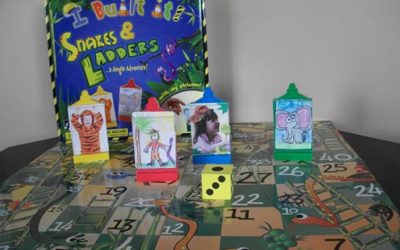
Mom picked up on of the bigger blocks and started to talk about the clever preschool teacher her daughter has. She said the teacher glued a picture of each of the children in the class onto the large blocks for play. Now the kids gather, take up their picture block and have conversations at the block area. This clever teacher has added conversation and encouraging language to a typically quieter activity.
Make sure you add people or animals or figures who can talk to your child’s pretend play scenarios. Children hone their conversational skills and social language through play.