“Angelina Ballerina Dance with Me! Game” Wins PAL Award

I had a chuckle as I walked past a little girl in her fluffy pink tutu the other day at a local farmer’s market. She didn’t seem one bit overdressed in what had to be her precious dance outfit. Now little girls can exercise their delight in ballet through a learning game. Here is my review:

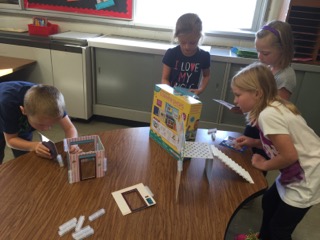
What little girl doesn’t want to be on stage showing off her dance moves? “Angelina Ballerina Dance With Me! Game” lets everyone be a star. I Can Do That! Games has done it again, creating a starter game for preschoolers that parents find fun too! Unfold the thick, vertical stage and attached game board, shuffle your dance move cards and start Angelina on her week of practice leading up to showtime. Each player takes a turn being Angelina, spinning a number, and advancing on the board. When a child lands on “New Move,” she picks a Dance Move card, places it on stage and tries the move herself. As more Dance Move cards are added to the string of arabesques and pirouettes, players have to remember the moves and the sequence to perform it correctly. Star cards with trophies are awarded for landing on spaces for practice, finding your dance shoes, fancy footwork and performing Dance Moves. Becoming a ballerina exercises the mind too as kids use visual memory and matching while imitating moves, remembering the sequence of  Dance Moves, and counting. Language learning is added as kids help each other remember moves, giving descriptions of how to match the dance position–”cross your legs,” “put your arms in a circle,” or “go on your tip toes.” In addition, your little ballerina has a beautiful portable stage to improvise for her next performance!

Posted in 3-6 year-olds, Games, Language, play, Preschool, Strategies to Encourange Language Development | Leave a comment

Richard Scarry’s Busytown Busy Busy Airport Game” Wins PAL Award

Want a great, flexible game that is loads of fun to use in Speech therapy sessions or family game night with your preschoolers? “Richard Scarry’s Busytown Busy Busy Airport Game” encourages pretend play within the game using props from Richard Scarry’s classic, “A Day at the Airport” and themed drawings venturing through categories of a travelling preschooler’s experience. Take off for the beach, city or the mountains and learn vocabulary, describe activities, find details and pretend to fly your plane.

Here is my review:

Fasten you seat belts and get ready for take-off from Busy Town Airport on your very own passenger plane. Part pretend play and part game, this latest product is signature “I Can Do that! Games” fun. The box itself is loaded with airport detail–an early latte kiosk, x-ray machine, security stops, and baggage claim  belt on the container’s bottom and shops selling bananas, books, flowers and snacks along the sides. Slip the control tower on the side of the box, assemble your airplanes, stand your passenger tiles in the slots of the floor of the airport, and place the destination cards around the room. Each card is a feast of Richard Scarry details around the theme of a mountain, forest, beach and city. Drop the dice down the top of the control tower, tumbling down to show two possible actions to take–involving loading a passenger in your plane or going to a destination. If a player chooses to fly her plane to a theme of fun, she drops off her passenger and picks up a souvenir to take home in her cargo slot. After all the passengers are delivered, players add up the numbers on their souvenir cards to determine the winner. Kids loved this game! It didn’t take long for them to add sound effects as they flew their planes to build sandcastles on the beach or go skiing in the mountains. The scenarios, loaded with rich detail abound with activities from building sandcastles to pitching a tent in the woods, providing an outstanding opportunity for language expression . Talking through choices of where to go, what passenger to pick, and activities on their theme card, kids can’t help but react to Scarry’s charming drawings. Talk about what activity you like best, or what you’ve experienced, drawing your child into a conversation about travel, experiences and fun.

Posted in 3-6 year-olds, Games, Language, play, Preschool, Strategies to Encourange Language Development | 2 Comments

Hands Off, Harry! by Rosemary Wells Wins PAL Award

Rosemary Wells has given us another gem–a book that entertains kids, teaches  lessons and can be used with individual kids or a a classroom of kindergators! I have used this book many times already for speech therapy lessons teaching about behavior and consequences, how we react and how to solve a problem. Here is my review:

Harry makes his entrance into the kindgergators’ classroom, running backwards and knocking his classmates out of Friendly Circle. Time out in the Thinking Chair doesn’t deter Harry’s behavior as he pokes, bumps, pushes and tackles Miracle, Benjamin, Babette and Nigel with frustrating results–spilled glue, ruined projects, splattered paint, and broken glasses. Harry’s peers have had enough. They vent at an emergency session of Miss Harmony’s Friendly Circle, problem solve and vote that Harry needs to learn about personal space. Babette comes up with a brilliant solution, which allows Harry to prove to the class that he gets it. Favorite children’s author, Rosemary Wells, deals with a common kindergarten problem–kids that can’t keep their hands to themselves–in a delightfully funny manner (even the kids’ names make you chuckle) as a classroom collectively shares a problem and goes about helping a peer. I’ve used this book for many language lessons, describing behaviors, consequences, and resulting feelings, explaining the concept of personal space or answering “why?” things happened. “Hands Off, Harry!” is a wealth of language lessons for classrooms, or individual cuddle time with your kid.

Posted in Uncategorized | Leave a comment

Summer Speech Therapy On the Road

August is a big vacation month so let’s talk about how to keep the language learning going. When I go on vacation, I am constantly learning new and unique information about the area that I am visiting. On our recent drive from Connecticut to Wisconsin, I am learn so much just observing the farms–how they are irrigated, planted and harvested. On this past trip we had a crop-duster plane swoop down right next to us on the highway and spray the fields. It was fascinating!

Several of my clients take several weeks off in August so I give the parents suggestions to carry on with my goals. A favorite idea is for the kids to keep a journal of their vacation–draw pictures or add photographs to their entires about what they did and learned that day. Have a discussion about their take on the day and share your favorite activities too.

When I was little our family took two big road trips west from Wisconsin and I collected postcards for my scrapbook. I made for great memories and of course a wonderful language learning exercise. Recently one of my moms showed me the scrapbook her 4 year-old had made from his trip to Washington DC with captions added by mom. He loved his little book and kept “reading” it to me.

Posted in 3-6 year-olds, 6-8 year-olds, 8 years and up, Elementary School Age, Language, Strategies to Encourange Language Development | Leave a comment

Kids Love PAL Award Book Winners

It’s always fun to test out my PAL Award winners with the grand kids so I brought along three of my recent favorites to test out with Caroline. Mom and Dad took a much deserved vacation alone, while Pop Pop and Sheshe held down the fort with one giggly, cuddly 3 year-old girl, a 15 month-old mountain goat who views his world as a big obstacle course to overcome, and two sweet dogs.

First I must say that grandparents should always bring along picture books that THEY enjoy because they will be reading them repeatedly throughout the visit. We stayed with “Hands Off, Harry! by Rosemary Wells, “I’m Not” by Pam Smallcomb and Robert Weinstock, and “Art and Max” by David Wiesner, all recent PAL Award winners that Caroline enjoyed just as much as I did. It was fun to see her take in the stories and absorb a little more of the relationships, inferred concepts, and main ideas as we read them over and over. She was especially fascinated with “Art and Max,” and could articulate some of the more abstract concepts such as when Art’s outline was pulled apart and slowly unraveled into a messy tangle of a line, I asked her, “Where is Art? to which she replied, “He’s in the line!”

Each of these books is a winner because it presents a creative story that invites kids to stretch their language as they ask, probe and re-tell the story.

Oh and by the way…we did indulge a little with the chocolate donut with sprinkles. Don’t tell the parents!

Here are my reviews:

“Art and Max”: Click here


“I’m Not” Click here

“Hands Off, Harry!” Click here

Posted in Uncategorized | Leave a comment

New Books to Teach Articulation and Reading

At my latest visit to our public library, I started my hunt at the “New Books” section as usual. I came upon a new series of books that are designed by Child’s World to assist children in phonics development. Of course, I looked at them for assisting children in articulation development because each story features a different sound/letter such as “Pam’s Trip to the Park” or “Ben, Billy and the Birdhouse.” Carefully written to control word count, sentence length, and vocabulary, the books have entertaining stories about packing a lunch for the park and visiting the petting zoo or building a birdhouse from a box of wood with best friend Billy. Look for the entire series to find the sound that your child is working on and use the book for speech therapy or give it to the parents to reinforce therapy at home. Encourage you child to make his or her own book using their target sound and illustrate it.


Posted in 3-6 year-olds, 6-8 year-olds, Articulation, Books, Reading | Leave a comment

Language Lesson for “Hands Off, Harry!” by Rosemary Wells

I have been using Rosemary Well’s newest book, “Hands Off, Harry!” for language lessons all week with kids who are on the autism spectrum or have language learning disabilities. What a terrific teaching tool!

Since summer is a time for vacations and families take off and might miss speech, I decided to make up a language lesson plan for a few moms of kids I work with that are on the autism spectrum so they can use books in my absence to build their child’s language. Here is what I shared with the parents:

Ways to Elicit and Expand Language Using “Hands Off, Harry” by Rosemary Wells, and other books:

  • Point out and talk about the title, who is the author, illustrator? What are their jobs?
  • From the cover picture, what do you think the book is about? What will happen? You may have to start your child with some ideas of your own such as, “What is Harry doing? Do you think he will keep doing that? What will happen?”  Praise any predictions and give a few of your own, showing that there is no right answer.
  • Review all the “characters” on the inside cover, using that term. Define characters (people, animals or other creatures in the story). Talk about the setting.
  • Start reading the story page by page (you may have to cover the print if he gets distracted by the letters, or prompt him saying, “Look at the picture, not the letters.” “We will write letters later.”
  • Have fun with the story. We read that Harry ran into school and said Good Morning backwards so we read and said it backwards too.
  • Expand his descriptions from “Harry ran backwards,” to “Harry ran backwards all the way down the hall and into his classroom,” prompting connecting words like those bolded above. Also, you can give a visual prompt of expanding his sentences as if you are pulling taffy with your hands and get farther apart as he gives more words, saying, “I want more language!”
  • After reading that Harry knocked kids out of Friendly Circle, ask, “What happened? Model novel words like, “Harry crashed into his friends.” How did the kids feel? Why didn’t the kids laugh?
  • Harry is sent to the Thinking Chair. “What does Harry do?” “What is personal space?” I had the kids make a circle in front of them with their arms and then practice putting their hands in and out of each other’s personal space. (invisible bubble around us where we feel safe, and if someone gets too close we are uncomfortable) What should Harry be thinking about?
  • Discuss each situation where Harry disrupts his classmate–MIracle making a snowflake, Benjamin painting, Nigel doing yoga–What did Harry do? Why are they mad? What should the class do?
  • Act out sections of the story to give kids multi-sensory reinforcement. Poke or surprise a friend, show the reaction, make the appropriate face and talk about the emotion, practice saying “I’m sorry” in the right and wrong voice. Why do we need to use the right voice? (so the person believes we are sorry)
  • What does it mean to have “ants in your pants?”
  • Why does Harry get a bumper tube? This is an abstract question and involves a lot of pulling concepts together so you may have to prompt him along in his answer: “Harry has the tube so______________ “or “When Harry wears the tube he can’t____________.”
  • Relate the book to your child’s experience. What do you like to take to show and tell, like Harry? Do you know a boy or girl like Harry?
  • Description: use a great page of illustrations to take turns describing something, expanding your child’s description with prompts. The playground page is perfect for this.
  • What did Harry do as playground monitor? Why was he good at it?
  • Discuss and show what it means to use your hands to shake, hold or lend a hand.
Posted in 3-6 year-olds, 6-8 year-olds, Books, Elementary School Age, Preschool, Strategies to Encourange Language Development | 1 Comment

Bloggers Win iPad2 and $1,000 For Their Charity

I just found out about an incredible opportunity for bloggers who promote education-related charities through social media. For the month of July, Bloganthropy.org is “partnering with P&G’s GIVE Education to honor another incredible Bloganthropy Blogger of the Month with an exceptional prize– $1,000 for your charity and an iPad2 for you.

In keeping with the P&G GIVE EDUCATION objective, our goal this month is to find candidates who are using social media to support education-related causes.

If you or someone you know uses blogging and social media for educational advocacy or charities, fill-out the Bloganthropy Blogger of the Month nomination form, right now!”

Today is the last day, and I am told that it only takes about 15 minutes to fill out the form. There is a possible high return for your efforts, and thanks for supporting education!

Posted in Uncategorized | Leave a comment

Short and Sweet Talk to Your Baby

In addition to your “running commentary” describing your activities like a reporter to your baby, you should have have some times of using short, tuneful, simple sentences such as “Up we go” or “Bounce up high.” Each activity—changing a diaper, watching his mobile, feeding and dressing, provides a backdrop for a series of little sentences. Diaper time could include “Pick your feet up,” “Rip off the tabs,” “Ooh, the diaper is wet,” “Wipe your bottom” and “Now you’re dry.” You will naturally use some of the same expressions during each activity and your baby will start to learn the vocabulary associated with that category of activity.

Always use grammatically correct sentences. Confused by mixed messages in child guidance books, parents ask me whether to use short phrases like, “Put shoe on” versus “Put Will’s shoe on.” If your child’s language is developing normally, you would talk to him in grammatically correct sentences like the latter example, including all pertinent parts of speech. Your child benefits from hearing all parts of the sentence.

If it materializes that your child is delayed, you can try a shorter version, sometimes called “telegraphic speech.” “Put shoe on,” for a child who is delayed in speech, reduces language and makes it easier to learn. Children developing normally are hard-wired to learn language from adults speaking correctly. No baby talk!

Posted in Babies, Birth-3 year-olds, Language, Strategies to Encourange Language Development | 2 Comments

“Word On the Street Junior” Wins PAL Award

This “wacky war of words” was unique and got even more fun, the longer we played it. The street is divided for two teams and the letter tiles of the alphabet run down the median strip. A team selects a category card–a school supply, something soft, or something found in a locker–and brainstorms words in that group. Times up and your team has to select one of the words and spell it out, moving the letter tiles to their side of the road, left or right. Three moves and your letter is off the board and “captured” by your team. The first team to capture eight letters wins. The thoughtful category cards and ensuing brainstorming is a wonderful language activity as players think of words connected by a concept. Strategy changes as the game progresses and there are fewer letters available to win. You can play offense or defense, look for double consonant words to speed your letters into  your camp, or try to formulate words using the letters on your half of the road. This game keeps the thinking going and changing for learning and fun.

Recommended Age: 8 and up

The above opinions are solely those of the author. “Word on the Street Junior” was provided for review by Out of the Box Publishing

Posted in 8 years and up, Games, Strategies to Encourange Language Development | 2 Comments