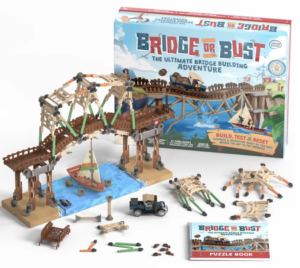
Part engineering challenge, part puzzle adventure, Bridge or Bust puts kids in the role of bridge designers as they build, test, troubleshoot, and improve their way through over 60 increasingly complex challenges. Players are tasked with constructing bridges that can span different distances, clear obstacles, and—most importantly—support a wind-up truck as it makes its journey across. With each new challenge introducing different parameters and constraints, kids quickly discover that successful engineering takes much more than simply putting pieces together.
We loved the natural progression of problem-solving skills throughout the challenges. Kids must first consider the problem, plan a possible solution, select and position their pieces, and then put their design to the ultimate test by sending the truck across. When a bridge comes crashing down, the learning really begins! Rather than supplying a single “right” way to build, Bridge or Bust encourages kids to assess and make strategic changes to their design. Should they add support? Change the position of a beam? Redistribute the weight? Try a different structure altogether? Each attempt exercises spatial reasoning, cause-and-effect thinking, planning, and persistence.
One of our favorite features is how easy it is to modify a design without completely rebuilding it. After a failed attempt, kids can snap the bridge back into place, identify the weak point, and make a targeted adjustment before testing again. This makes trial and error feel productive rather than frustrating and beautifully demonstrates the engineering design process: build, test, evaluate, modify, and try again. Kids practice flexible thinking as they learn to move away from an idea that isn’t working, while also recognizing that solving a problem doesn’t always mean starting over. Sometimes one thoughtful change is all it takes!
While Bridge or Bust offers plenty of independent brain-building, we especially enjoyed the language opportunities that emerge when kids tackle a challenge with a partner, sibling, parent, or group. Collaborative building requires players to explain their ideas, listen to another perspective, ask and answer questions, negotiate different solutions, and use increasingly specific vocabulary to describe where and how pieces should be placed. Conversations like, “What if we move this support closer to the middle?” or “I think this side needs more support because…” encourage kids to verbalize their reasoning rather than simply arriving at an answer.
Bridge or Bust turns engineering into an engaging, hands-on adventure where even a spectacular collapse is part of the fun—and part of the learning. We love a toy that gives kids permission to fail, rethink, communicate, and try something new. From spatial reasoning and STEM concepts to flexible thinking, problem solving, cooperative language, and idea sharing, there’s a tremendous amount of learning built into every bridge—whether it holds or goes bust!
Available at Upper Story