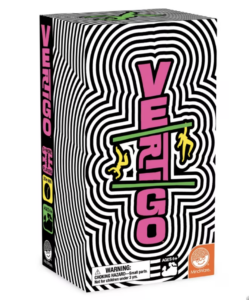
Vertigo is a suspenseful stacking game where careful planning and a steady hand can mean the difference between building high and watching it all come crashing down. Players roll the dice and take turns adding walls, ceilings, beams, and playful “Vertigoers” to an increasingly precarious tower. With every new piece, players must consider balance, placement, and what their choices might mean several turns down the road.
The hands-on construction strengthens fine motor skills and hand-eye coordination. Players observe the existing structure, predict how a new piece might affect its stability, and make decisions about where it can safely be placed. As the tower grows, so does the challenge, encouraging spatial reasoning, problem-solving, cause-and-effect thinking, and cognitive flexibility. Surprise battle rounds can change the course of play, requiring kids to adjust their plans and take calculated risks rather than relying on a single strategy.
There’s plenty of language learning built into all that suspense, too. Players use spatial and positional vocabulary as they discuss placing pieces above, below, beside, across, or between others, while descriptive and comparative language comes into play when evaluating which location looks stronger, steadier, taller, or more balanced. Playing together also encourages kids to explain their reasoning, make predictions, listen to other players, and react to changing conditions—great practice for expressive language, verbal reasoning, and conversational turn-taking.
Vertigo makes thinking visible. Kids can immediately see the consequences of each decision and use that information to guide their next move. With strategy, spatial reasoning, language, and plenty of suspense packed into every growing tower, players will be holding their breath—and exercising their brains—right up until the final piece!
Available at MindWare