We are always looking for fun free downloads to use for speech therapy activities. www.alphamom.com has been a great source for free valentines and this year they posted several options for free vintage and retro valentines for kids.

Use them for a reinforcing activity for articulation or incorporate them into a language lesson on spacial concepts, descriptions, sequencing or other goals.

Other options for fun free printable valentines are linked on the site as well. So get out your scissors and glue and have some fun this week!

I work with several children with articulation goals–aged 3-7. Lately, several of them are at the same stage of trying to carry over the correct production of their sounds. They are able to produce the sounds correctly in sentences but when we move to conversation or during an activity, they are not as accurate. I start with increasing their auditory discrimination of correct and incorrect sounds in my speech and move to recognition in their speech. I ask them to give me a thumbs up if I said it a good or bad way. They have fun with that. Then we focus attention of listening to them.

The other day, a five-year-old girl taught me a great strategy. She said a word incorrectly while she was talking, then looked up at me and said, “I will fix that,” and proceeded to correct herself! I saw two more children that day in a similar stage in therapy and tried that same line. “Can you fix that?” Somehow the kids loved the idea of them fixing their speech, not me!

Another little boy corrected himself, seemed surprised, looked at me and said, “I fixed that!” It is a wonderful way to teach kids to be responsible for their speech carryover as well as build auditory awareness and discrimination skills.

Try this out and let me know what ideas you use to effect carryover of sounds you are working on.

It’s time to talk about love, hugs and kisses and use some fun stories to work on children’s speech and language goals. More books are included in last year’s blogs.

Here are some fun books for preschoolers and early elementary aged students to encourage language:

Max’s Valentine by Rosemary Wells

Max of course wants to sabotage Ruby’s activity making valentines by eating the candy, yum yum glitter and all. Finally Max gets his own valentine delivered from Grandma, full of chocolate ants!

  • Use the story to talk about sequence–making valentines, mail them, receive them.
  • Create your own valentines with lots of options for fun candies to glue on the hearts
  • Practice sounds and language structures as the child re-tells the story.
The Giant Hug by Hornug
Owen wants to send his granny a big hug for her birthday. A picture of a hug won’t do so he starts with the first step–he gives a big hug to Mr. Nevin, working the counter at the post office, and asks him to pass it on to his granny. Each step of the way, the hug is passed on until granny is found in her garden and receives her gift.
  • Re-tell the story using drawings, or objects representing the different steps a letter or package goes through to get to its recipient–letter sorter, truck driver, airplane captain, mail truck driver and mailman.
  • Change the story with each child offering what gesture or words they would like to “send” through the mail.
Won’t You Be My Kissaroo? by Ryder and Sweet
Equally loved as Won’t You Be My Hugaroo? this book is great for a toddler but can start a good language discussion for an older child. Each kiss illustrated has its own adjectives–”a morning kiss is full of sun and wishes for the day to come.” A breakfast kiss can be sticky or a good-bye kiss can be safe. The author cleverly adds upon each kiss until there is a surprise kiss with all the animals gathered for a birthday party.
  • Talk about the words that describe each kiss. Add more thoughts or adjectives to each one–a breakfast kiss could be slurpy, buttery or tasty.
  • Draw and cut out pictures of different lips to represent each kiss, add your own and write out the words that describe the kiss.

play Horton Hears a WhoWhen you keep kids engaged and entertained, they don’t even know that they are practicing their speech! I had two new kids this week who were playing a game with me and after about 30 minutes they looked up and said, “Let’s do it without the words.” (Meaning, let’s just play and not practice words!!) Of course there has to be a little work in a session but if done right, kids aren’t very aware of it.

Last week I took the game, Horton Hears a Who! by I Can Do That Games. It was a real hoot. I played it with from one to three kids from age 3-7. They loved it. The best part is hiding the clovers around the room and when you land on a clover piece on the game board, you put on the elephant face and have to pick up a velcroed clover with the tip of your trunk! Kids quickly catch on and want to get a chance to be Horton. It’s a great reinforcing game after several practice turns for articulation or language goals. Or, use it for carryover and get the whole family to join in if you deliver your services in the home.

“Horton Hears a Who” was provided by I Can Do That Games.The opinions expressed in this review are solely those of the author.

preschool pretend playIt has always been my objective to have parents involved in their child’s therapy process. Sometimes I feel like I get almost twice the progress when parents watch, learn and implement my strategies for their child’s speech and language goals. It is important to work with the child and explain to the parents as you go along, what words, pauses, and methods you are using to encourage their child’s language. Explain how you are getting their child to practice certain sounds or language concepts.

At times, I pull back and have the parent work with the child in the same manner that I have modeled so when I am gone and they are playing, the parent is confident in the methods to elicit speech and language.

Occasionally, it doesn’t work to have a parent sit in on the sessions. For whatever reason, the child is less cooperative, wants to sit in mommy’s lap instead of play with me or is distracted. In that case, I ask the parent to leave the room (usually they sit around the corner so they can hear what we are doing) and they see the benefit as their child is settling in and responding. I use the last few minutes of the session to invite the parent back and show what we were doing.

I know including parents is difficult in a school setting with groups of children when you have to be concerned about confidentiality.

Let me know how you therapists deal with that in a school setting. Leave a comment below.

I just got a note from Marshalla Speech and Language, pointing me to Pam Marshalla’s new free videos on YouTube, demonstrating her cues for consonants. She has developed a helpful system of hand cues to focus a child on placement of sounds. I watched her video and tried them out with a few of my 3 year-olds who keep confusing /k/ and /t/. They were helpful and the kids started to use the cues themselves! Try them out.

What cues do you find helpful in articulation therapy? Share with us in the comments below.

It’s time to put away the Halloween costumes and talk turkey, preparing for Thanksgiving. Preschools are busy painting feet and hands to provide the body for a feathered turkey, and using play doh for turkey feasts.

Today I was working with a 3 year-old on /k/ and /g/ and found a turkey to be the perfect thing to get him going with back placement of his tongue. This little guy loves to pretend play with small representational toys, such as the Fisher Price little people, so he started out on a trip to the camping grounds for a picnic and we decided to make turkeys out of play doh. Taking a cooler on our picnic of turkey and gravy offered many opportunities to practice /k/ and /g/.

Max and Ruby were waiting for the feast as we rolled out the dough and used our turkey cookie cutter to make the picnic.

As a speech therapist, we have to be flexible and follow the child’s lead and interests even on the best planned day.

Yesterday, I carried two stuffed bags of toys into the home of 3 year-old Duncan. I had printed out pictures of /k/ words for articulation therapy. I thought he would enjoy cutting and pasting them on cards and loading and dumping them in my variety of trucks. Well, he took a liking to my Fisher Price garbage truck and before we could paste any pictures he was enjoying crumpling them up and loading up the truck, shutting the back to the crunching sound, and hauling them off to the dump!

I got so many responses to my naming the pictures, handing them to him, and his stuffing them in the garbage truck. Of course the pictures didn’t survive more than one session but that way okay. We did what Duncan wanted to do that day and he was full of language as a result!

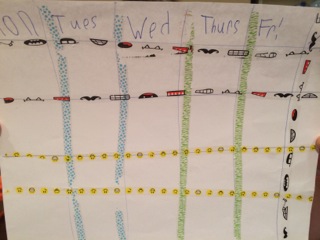
Child's responsibility chartWhen I came to Reagan’s house this week, Mom looked a little disappointed that Reagan had not wanted to practice her speech as she usually did. As we know as therapists, kids that practice in our absence make more progress! So, knowing how Reagan likes crafts, I suggested she make a fun chart and put a stamp on each day when she practiced so I could see it next week when I come.

Mom offered an even better idea. She said, “Let’s add it to your “Responsibility Chart!” She showed me the changeable wooden chart made by Melissa and Doug that hung on the wall. Along with pre-scripted responsibilities like “Brush your Teeth,” “Stop Whining,” and “Hands to Yourself,” there were blank cards to add personal responsibilities specific to your child. Mom immediately wrote “Speech” on the blank strip and we were ready to practice. The circular magnetic discs to fill in when you accomplished your tasks are rewarding to the child as they pick “Way to Go,” “Super,” or “Awesome to add to the chart.

What ideas are you using to encourage your child to practice their speech goals between sessions? Share in the comments below.

toddler in pumpkin patchI watched a wonderful interaction between mother and child today during our speech therapy session. It is exciting for me to see my little clients improve, but just as satisfying to watch parents learn how to encourage speech and language.

Little two-year-old Sean loves my three dollar plastic pretend microphone. He selected it out of my bag and started to make sounds into it. Mom held the mike and began to imitate Sean. Much to his delight he continued in their “conversation,” offering up new sounds and syllables, waiting for Mom to imitate. Ever so gradually, Mom began to slightly change what Sean was saying. He said “ba” and she replied “ba ba.” Slowly the roles reversed and Sean started to imitate mom so now he was having to match what mom was saying. He was learning the fun of producing sounds, having a conversation and imitating sounds all at once. By the way, Mom was having fun too!

Whenever we teach parents how to stimulate speech and language, they become a big part of their child’s progress.